By

August 21, 2026
Can a Non-UK Resident Director Open a UK Business Bank Account?
Yes, a non-UK resident director can potentially open a business account for a UK limited company. However, the process can be more difficult than it is for a UK-resident director because individual banks and payment providers set their own eligibility requirements.
Some providers require the applicant or at least one company director to live in the UK, while others may consider UK companies whose directors and shareholders live overseas. UK government business guidance also notes that businesses with foreign directors or owners can face additional identity, security and compliance checks when applying for a UK business bank account.
Yes. A UK limited company can have directors who live outside the United Kingdom.
The director's country of residence and the company's country of incorporation are separate matters. A company can therefore be registered in the UK while its director manages the business from another country.
However, being able to operate a UK company as a non-resident does not automatically mean every UK bank will accept the company.
Banks and payment institutions establish their own onboarding and risk policies.
Potentially, yes.
There are business account providers that consider companies with overseas directors, although the available options may be more limited.
Traditional business bank accounts can have stricter residency requirements. For example, some mainstream account products explicitly require the applicant to be a UK resident, even when the company itself is incorporated in the UK.
Other financial institutions and payment providers may have different eligibility criteria.
The important distinction is:
UK company registration does not guarantee business account approval.
Each application is assessed according to the provider's own compliance and risk requirements.
Financial institutions must understand who owns and controls the company and how the account will be used.
When directors or shareholders live overseas, additional verification may be required.
UK government guidance specifically notes that banks may carry out additional checks when a company has foreign investors, directors or owners.
Providers may examine factors including:
A straightforward trading company with clearly documented business activity may therefore have a different risk profile from a company with a complex international ownership structure.
Requirements vary between providers, but a company will commonly need to provide information about both the business and the people controlling it.
This can include:
Government guidance indicates that banks may also request a UK business plan explaining why the company requires a UK account, particularly in international-business cases.
It depends on the provider.
Some business account products specifically require the applicant to be a UK resident and may also require the company to have a UK trading address.
Other providers may consider directors living overseas.
Having a UK registered office for the company should therefore not be confused with the director personally being a UK resident.
A UK limited company must maintain an appropriate registered office address in the part of the UK where it is registered.
However, financial institutions may distinguish between:
Registered office address — the official Companies House address.
Trading address — where the company's actual business activities take place.
Director's residential address — where the individual director lives.
A provider may ask for information about all three.
Possibly.
Some providers use digital onboarding systems that allow identity and company verification to be completed remotely.
Other institutions may require additional documentation or in-person verification.
UK government guidance for international businesses notes that opening a full traditional UK business bank account can involve additional checks and, in some cases, a UK meeting with a company representative.
The process therefore varies significantly depending on the type of account and provider.
Not always.
Some digital business account and payment providers may allow the entire application to be completed remotely.
Traditional banking arrangements can be different. Government guidance for international businesses indicates that some full UK banking applications may require a company representative to meet the bank in the UK.
Businesses should check this requirement before beginning an application.
Potentially, yes.
A company does not necessarily need a long trading history before applying.
However, a newly incorporated company may have limited financial records, so the provider may request additional evidence explaining what the business intends to do.
This could include:
The objective is generally to demonstrate that the company has a genuine and understandable business purpose.
Potentially.
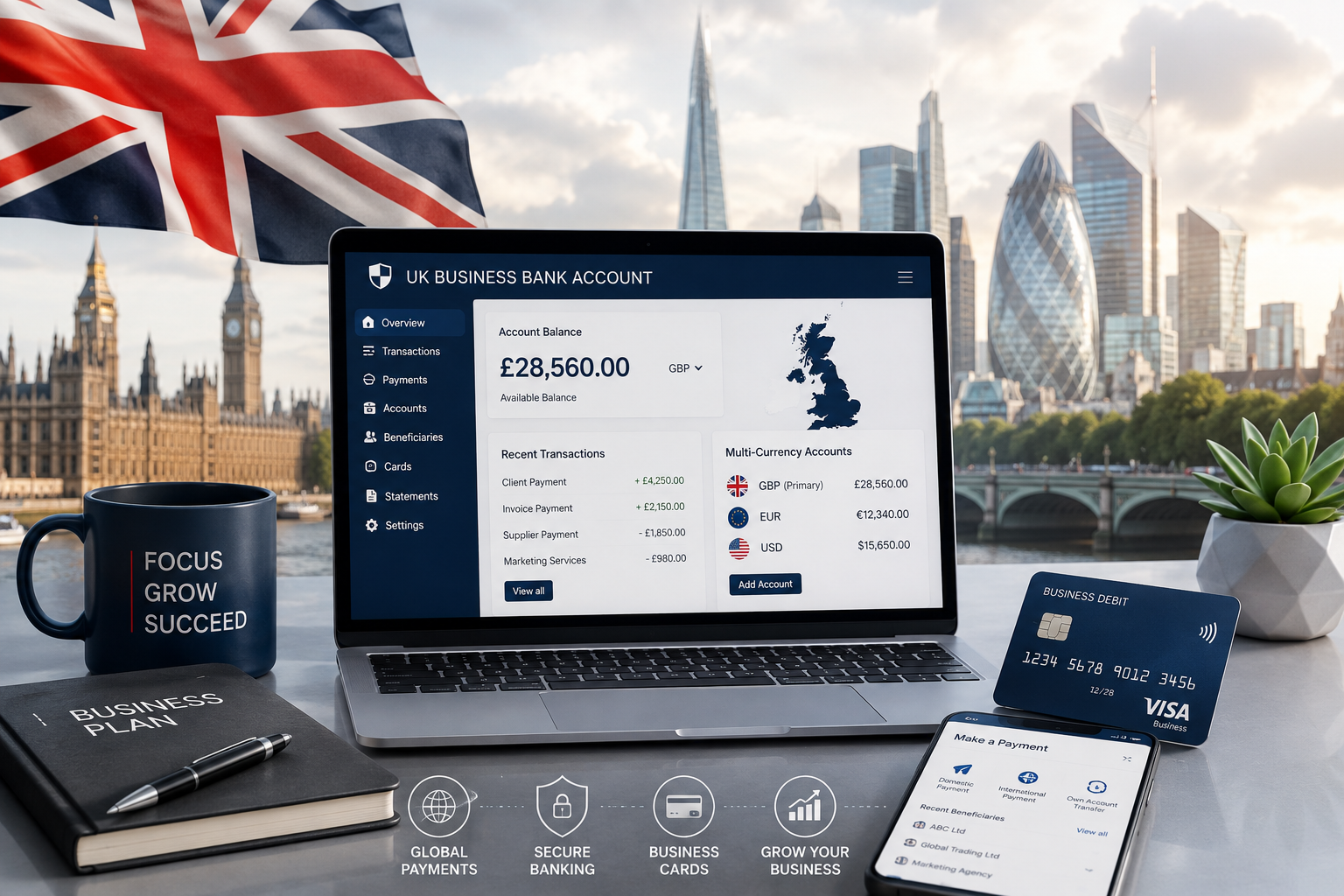
For an internationally managed UK company, a multicurrency business account may sometimes be more relevant than a traditional GBP-only account.
Depending on the provider, a company may be able to manage currencies such as:
GBP — British pounds
EUR — euros
USD — US dollars
Other currencies may also be available.
This can be useful when the company receives money from customers in one country and pays suppliers in another.
Yes, provided its account supports EUR payments.
For example, a UK company could potentially:
Receive EUR → Maintain EUR → Pay European supplier
or:
Receive EUR → Convert EUR to GBP → Pay UK expenses
The exact functionality depends on the account provider.
Yes, if its business account provides the necessary USD payment capabilities.
This can be useful for companies selling products or services to customers in the United States or other markets where invoices are denominated in US dollars.
Depending on the account, the company may then maintain USD, make USD payments or convert the funds into GBP or EUR.
Potentially.
Some business account and payment providers can provide eligible UK companies with an IBAN for receiving supported payments.
The IBAN's country code and payment capabilities depend on the financial institution providing the account.
Businesses should therefore check whether they require:
The right solution depends on where customers and suppliers are located.
Potentially.
Some financial institutions provide eligible businesses with Virtual IBANs (vIBANs).
A virtual IBAN can provide unique payment details connected to underlying account infrastructure.
This may be particularly useful for international businesses that receive payments from numerous customers and need an easier way to identify and reconcile incoming transfers.
Account approval is never guaranteed.
Common factors that can make an application more difficult include:
Providing complete and accurate information from the beginning can help reduce unnecessary delays.
A UK limited company's finances must be kept separate from the personal finances of its owners and directors. GOV.UK specifically states that a company's banking must be separate from personal banking because the company is a separate legal entity.
A director should therefore avoid treating a personal account as the company's operating account.
Keeping company finances separate also makes bookkeeping, transaction monitoring and financial reporting considerably clearer.
Non-resident directors should look beyond whether an application is simply accepted.
Consider whether the account actually supports the company's business model.
Important features can include:
For an international company, foreign exchange costs can also be particularly important.
Potentially, yes. Some providers consider UK companies with directors living overseas, while others require UK residency.
Not necessarily. Citizenship and residency are different considerations, and account eligibility is determined by the individual financial institution.
Not simply for business-account eligibility as a universal rule. However, individual account providers may impose a UK-residency requirement.
Some providers support remote onboarding, while others may require additional verification or an in-person meeting.
Potentially. Some multicurrency business account providers support several currencies for eligible UK companies.
No. Registering a UK company and being approved for a financial account are separate processes.
A non-UK resident director can potentially open a business account for a UK limited company, but the choice of provider may be more limited than for a UK-resident director.
The most important factors are usually the director's country of residence, the company's business activities, ownership structure, source of funds and expected transactions.
For internationally operated UK companies, it can also be worth considering an account that supports GBP, EUR and USD, multicurrency payments, currency conversion, SEPA and international transfers, rather than focusing exclusively on a conventional GBP business bank account.