By

August 21, 2026
Can a Non-UK Resident Open a Business Account for a UK E-Commerce Company?
Yes, potentially. A non-UK resident can own and run a UK e-commerce company, and some business account providers accept UK companies whose directors live overseas. However, not every bank or financial provider accepts non-UK resident directors.
A UK limited company can have directors who live outside the United Kingdom. The key issue when opening a business account is whether the provider supports your country of residence, e-commerce business model, ownership structure and expected transactions.
Yes.
A UK limited company can have directors and shareholders who live overseas.
For example:
Company: UK limited company
Director: Resident overseas
Registered office: United Kingdom
Customers: UK, Europe and US
Suppliers: UK, Europe and Asia
However, being able to own and operate a UK company does not automatically mean every UK business account provider will accept the company.
Some do, while others require directors to live in the UK.
Each provider has its own eligibility requirements.
Before applying, check whether it accepts:
Checking eligibility before applying can help avoid unnecessary applications and potential rejections.
Not necessarily.
An overseas director can provide their genuine foreign residential address.
The account provider may request proof of that address, such as an accepted bank statement, utility bill or government document.
For example:
Company registered office: United Kingdom
Director residential address: France
The company's UK registered office should not be presented as the director's residential address unless the director genuinely lives there.
A UK limited company must have a UK registered office address.
However, there is an important distinction between:
Registered office address — the company's official UK address.
Trading address — where the company actually conducts business.
Director's residential address — where the director personally lives.
Some account providers may accept a UK registered office combined with an overseas trading or director address.
Others may require evidence of a genuine UK business presence.
Requirements therefore vary considerably.
Potentially.
A virtual office or registered-office service may be suitable for the company's registered office if it meets the relevant requirements.
However:
Registered office acceptance does not automatically mean business account acceptance.
A financial provider may distinguish between:
Check the provider's requirements before submitting an application.
Potentially.
Some digital business account providers support remote onboarding.
A typical application could involve:
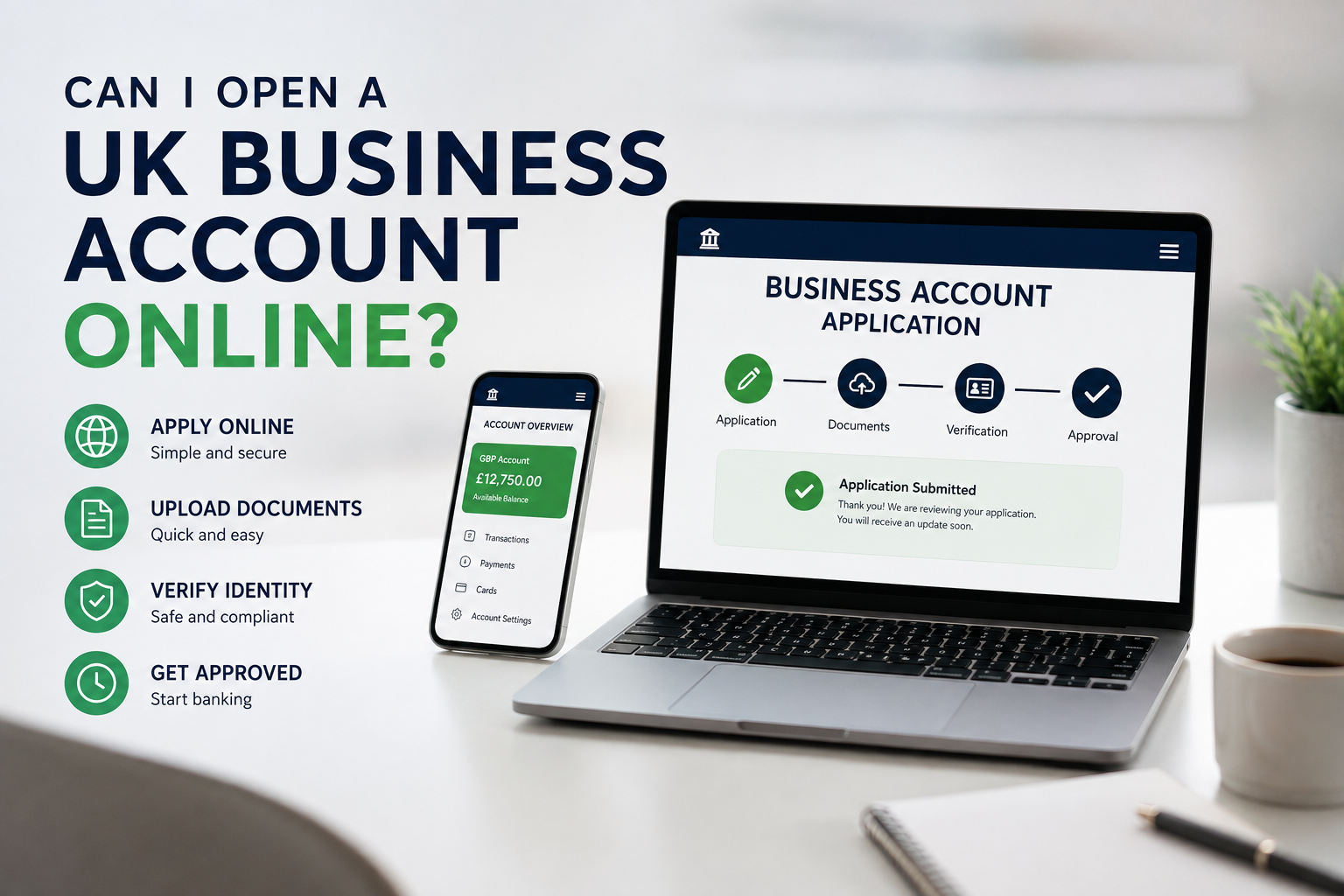
Online application → Company verification → Director verification → Business review → Compliance checks → Account decision
The director may be able to complete identity verification remotely using a passport, photograph, selfie or video verification.
Traditional banks may have different requirements and could require additional documentation or an in-person process.
Requirements vary, but you may need:
The provider may request additional documents depending on the business.
E-commerce businesses can have complex international payment flows.
The provider may want to know:
What products do you sell?
Where are your customers located?
Where are your suppliers located?
Which marketplaces do you use?
Which payment processors do you use?
Which currencies do you receive?
Which currencies do you send?
What monthly turnover do you expect?
The objective is to understand how money will enter and leave the account.
For an e-commerce company, the website can help demonstrate what the business actually does.
Ideally, it should clearly show:
The website should also be consistent with the business-account application.
For example, if the application describes the company as an electronics retailer but the website sells clothing, the provider may request clarification.
Potentially.
A newly incorporated company may not have previous business account statements or an established trading history.
The provider may therefore ask for additional evidence such as:
Providing clear information about the company's intended activities can make the application easier to assess.
Potentially.
For an internationally operated e-commerce company, a multicurrency business account can be particularly useful.
Depending on the provider, the company may be able to manage:
GBP — UK customers and expenses
EUR — European customers and suppliers
USD — US customers and international suppliers
This can help an international e-commerce business manage revenue and expenses without automatically converting every payment into GBP.
Yes, provided the account supports GBP payments.
GBP can be useful for:
A UK e-commerce company may require GBP payment capabilities even when its directors live overseas.
Potentially.
If your company sells to European customers, receiving EUR can be useful.
For example:
European sales → Receive EUR → Pay European supplier
or:
Receive EUR → Convert EUR to GBP
Businesses regularly dealing with European payments may also want an EUR IBAN and SEPA payment capabilities.
Potentially.
USD can be valuable for companies selling to US customers or paying international suppliers.
For example:
US sales → Receive USD → Keep USD → Pay supplier in USD
This can avoid unnecessary conversions such as:
USD → GBP → USD
when both revenue and expenses are denominated in dollars.
Potentially.
Marketplace sellers should confirm that the marketplace accepts the business account details being provided.
Check:
The fact that a provider accepts e-commerce businesses does not automatically mean every marketplace will accept its account details.
Potentially.
A typical e-commerce payment flow could be:
Customer → Online checkout → Payment processor → Business account
For an international business, the company may want:
GBP sales → GBP balance
EUR sales → EUR balance
USD sales → USD balance
Whether this is possible depends on both the payment processor and the business account.
Potentially.
A suitable international business account may allow the company to send payments to suppliers overseas.
For example:
Receive GBP → Convert GBP to USD → Pay supplier
or:
Receive USD → Keep USD → Pay supplier directly
Businesses making frequent international payments should pay particular attention to:
These costs can become significant as an e-commerce business grows.
Financial providers need to verify the people who own and control a company.
An international application may therefore involve verification of:
Director → Identity + residential address
Shareholders → Identity + ownership
Company → Registration + business activity
Transactions → Customers + suppliers + countries
Funds → Source + expected volumes
This can make applications involving overseas directors more detailed than straightforward domestic applications.
Possible reasons include:
A rejection does not necessarily mean there is a problem with the UK company.
It may simply fall outside that particular provider's eligibility requirements.
Neither option is automatically better.
A traditional bank may provide a broader range of conventional banking services.
Digital financial providers may offer features particularly useful for international e-commerce companies, such as:
For an internationally operated e-commerce company, important features may include:
GBP + EUR + USD + IBAN + SEPA + International Payments + Currency Conversion
Eligibility should always come first.
There is little value comparing account fees and exchange rates if the provider does not accept directors from your country of residence.
A UK limited company is legally separate from its directors and shareholders.
Company finances should therefore be kept separate from directors' personal finances.
This is particularly important for e-commerce businesses processing numerous:
A dedicated business account makes these transactions easier to manage and reconcile.
Consider the following business:
Company: UK limited company
Director: Lives overseas
Customers: UK, Europe and US
Sales currencies: GBP, EUR and USD
Suppliers: UK, Europe and Asia
The company may need an account capable of:
Receive GBP → Pay UK expenses
Receive EUR → Pay European suppliers
Receive USD → Pay international suppliers
Convert currencies → When required
For this type of company, a multicurrency business account may be more suitable than a basic GBP-only account.
Before submitting an application, check whether the provider:
Checking these points first can save considerable time.
Yes. A UK limited company can have directors and shareholders who live overseas.
Potentially. Some providers accept overseas directors, while others require UK residency.
Not necessarily. An overseas director can provide their genuine foreign residential address. However, the company itself must have an appropriate UK registered office.
Potentially. Some digital providers support remote applications and identity verification.
Potentially, subject to the provider's eligibility requirements.
Potentially. A suitable multicurrency account may support all three currencies.
Potentially. Some providers offer eligible UK companies EUR payment details or an IBAN.
No. Registering a UK company does not automatically make the company eligible for every business account.
Yes, a non-UK resident can potentially open a business account for a UK e-commerce company, but the provider must accept overseas directors and your particular country of residence.
The main challenge is usually not owning the UK company. It is finding a business account whose eligibility requirements match the company's directors, ownership structure, e-commerce activity, customer countries, supplier countries and expected transactions.
For an international e-commerce company, a multicurrency account can be particularly useful if it supports:
GBP + EUR + USD + IBAN + SEPA + International Payments + Currency Conversion
The ideal account should match the company's complete payment flow:
Receive customer payments → Manage multiple currencies → Convert when necessary → Pay suppliers internationally.