By

August 21, 2026
Can a UK E-Commerce Company With an Overseas Director Open a Business Account?
Yes, potentially. A UK e-commerce company with an overseas director can open a business account, provided the financial provider accepts non-UK resident directors and supports the company’s e-commerce activities.
UK company directors do not have to live in the UK. The main consideration is whether the chosen account provider accepts the director’s country of residence, company structure, e-commerce business model and expected payment activity.
Yes.
A UK limited company can have a director living outside the UK.
For example:
Company: UK limited company
Director: Lives overseas
Registered office: United Kingdom
Business: E-commerce
Customers: UK, Europe and US
Suppliers: UK, Europe and Asia
Having an overseas director does not prevent the company from operating as a UK limited company.
However, business account providers have their own eligibility requirements.
No.
Some providers require directors to be UK residents, while others may accept companies managed by directors living overseas.
Before applying, establish whether the provider accepts:
Eligibility should be checked before comparing account features.
Not necessarily.
An overseas director can provide their genuine residential address outside the UK.
The account provider may request proof of that address, such as an accepted:
The exact documentation depends on the provider.
You should not use the company's registered office as your residential address unless you genuinely live there.
Yes.
A UK limited company must maintain an appropriate registered office address in the UK.
However, it is important to distinguish between:
Registered office — the company's official UK address.
Trading address — where the business actually operates.
Director's residential address — where the director personally lives.
For an internationally operated e-commerce company, these addresses do not necessarily have to be the same.
Not always.
Each account provider establishes its own address requirements.
Some may accept a UK registered office combined with an overseas director and overseas trading address.
Others may require evidence of a genuine UK business presence or trading address.
Therefore:
Having a UK registered office does not automatically guarantee eligibility for a business account.
Check the provider's requirements before applying.
Potentially.
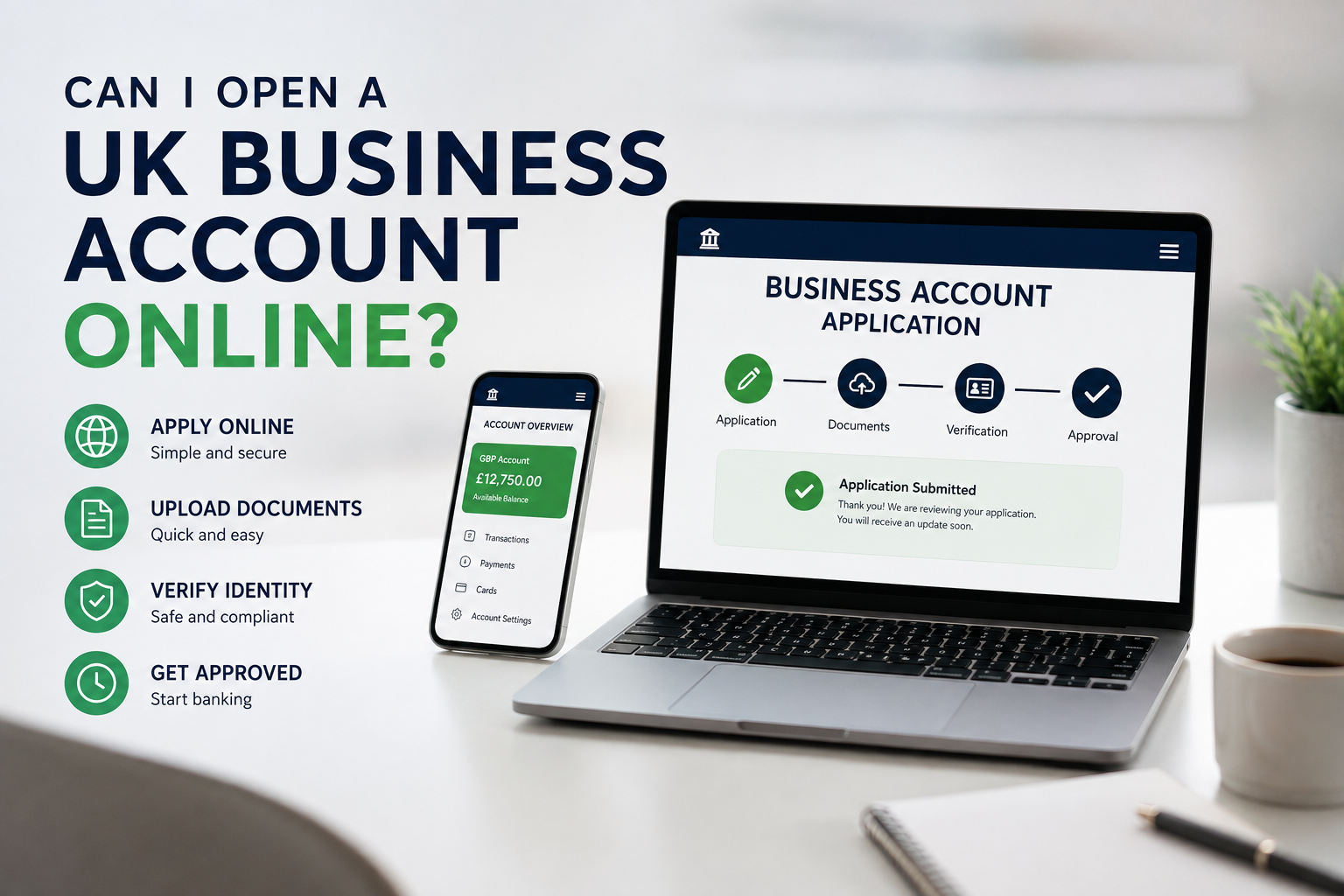
Some digital business account providers allow applications and verification to be completed remotely.
A typical process may involve:
Online application → Company verification → Director verification → Business review → Compliance checks → Account decision
Depending on the provider, the director may be able to complete identity verification using a passport, photograph, selfie or video verification.
Traditional banks may have different requirements and could require additional documentation or an in-person meeting.
Requirements vary, but you should generally be prepared to provide:
Additional documentation may be requested depending on the company and its activities.
E-commerce businesses can have relatively complex payment flows.
The account provider may want to know:
What products does the company sell?
Where are customers located?
Where are suppliers located?
Which marketplaces does the company use?
Which payment processors does it use?
Which currencies will it receive?
Which countries will it send money to?
What turnover does it expect?
The provider needs to understand how money is expected to enter and leave the account.
Your website can help demonstrate the nature of your business.
Ideally, it should clearly display:
The website should also be consistent with the information provided in the business account application.
For example:
Application: Consumer electronics retailer
Website: Consumer electronics
Supplier invoices: Consumer electronics
This provides a clear and consistent picture of the company's activities.
Potentially.
A newly incorporated company may not have an established transaction history, so the provider may request additional information.
This could include:
New businesses should be prepared to explain clearly how the company intends to generate revenue.
Potentially.
For an internationally operated e-commerce company, a multicurrency business account can be particularly useful.
Depending on the provider, the company may be able to manage:
GBP — UK customers and expenses
EUR — European customers and suppliers
USD — US customers and international suppliers
This allows the company's payment infrastructure to better match its international trading activities.
Yes, provided the account supports GBP payments.
A UK e-commerce company may use GBP for:
The fact that the director lives overseas does not necessarily prevent the company from receiving GBP.
Potentially.
For example:
European customer → EUR → Company's EUR balance
The company could then potentially:
Keep EUR → Pay European supplier
or:
Convert EUR → GBP
Companies regularly trading with Europe may also benefit from an EUR IBAN and SEPA payment capabilities.
Potentially.
USD can be particularly useful for international e-commerce businesses.
For example:
US sales → Receive USD → Keep USD → Pay USD supplier
This may avoid unnecessary conversions such as:
USD → GBP → USD
when both revenue and supplier expenses are denominated in dollars.
Potentially.
The company should check whether each marketplace accepts the particular account details being provided.
Important considerations include:
Marketplace eligibility and business account eligibility are separate issues.
Potentially.
A common payment flow is:
Customer → Online checkout → Payment processor → Business account
An international e-commerce business may want a setup where:
GBP sales → GBP balance
EUR sales → EUR balance
USD sales → USD balance
Whether this is possible depends on both the payment processor and the business account provider.
Potentially.
International supplier payments are particularly important for e-commerce businesses importing products or using overseas fulfilment services.
For example:
Receive GBP → Convert GBP to USD → Pay supplier
Alternatively:
Receive USD → Keep USD → Pay supplier in USD
The second arrangement can help avoid an unnecessary currency conversion.
Having an overseas director is only one factor considered during an application.
Possible reasons include:
A rejection does not necessarily mean there is a problem with the company.
It may simply mean the company falls outside that provider's eligibility criteria.
Provide a clear explanation of the company's business model.
For example:
Business activity: Online retailer selling home and technology products.
Customers: UK, EU and US.
Suppliers: UK, Europe and Asia.
Expected currencies: GBP, EUR and USD.
Incoming payments: Marketplace and payment-processor settlements.
Outgoing payments: Suppliers, advertising, shipping and software.
Expected annual turnover: Realistic estimate based on the company's plans.
This gives the provider considerably more information than simply describing the business as "e-commerce."
A UK limited company is legally separate from its directors and shareholders.
Company finances should therefore be kept separate from the personal finances of directors.
This is especially important for e-commerce companies processing numerous:
A dedicated business account creates a clearer record of company transactions.
Consider:
Company: UK limited company
Director: Lives overseas
Customers: UK, Europe and US
Revenue: GBP, EUR and USD
Suppliers: UK, Europe and Asia
An appropriate multicurrency setup could potentially allow:
Receive GBP → Pay UK expenses
Receive EUR → Pay European suppliers
Receive USD → Pay international suppliers
Convert currencies → When required
For this type of international e-commerce company, multicurrency capabilities may be considerably more useful than a basic GBP-only account.
Before applying, establish whether the provider:
Checking these requirements before applying can save considerable time.
Yes. A UK limited company can have directors who live outside the UK.
Potentially. It depends on whether the provider accepts non-UK resident directors and the director's country of residence.
Not necessarily. An overseas director can provide their genuine foreign residential address.
A UK limited company must maintain an appropriate UK registered office address.
Potentially. Some digital providers support remote onboarding, while other providers may have additional requirements.
Potentially, subject to the provider's eligibility and compliance requirements.
Potentially. A suitable multicurrency business account may support all three currencies.
Potentially. Some providers offer eligible UK companies EUR payment details or an IBAN.
No. UK incorporation does not automatically make a company eligible for every business account.
Yes, a UK e-commerce company with an overseas director can potentially open a business account. The key is finding a provider whose eligibility requirements match the company's circumstances.
Before applying, check whether the provider supports the director's country of residence, e-commerce business model, customer and supplier countries, expected transaction volumes and required currencies.
For an international e-commerce company, a multicurrency account can be particularly useful if it supports:
GBP + EUR + USD + Multicurrency + IBAN + SEPA + International Payments + Currency Conversion
The account should ultimately match the company's complete payment flow:
Receive customer payments → Manage currencies → Convert when necessary → Pay suppliers internationally.