By

August 21, 2026
Can I Open an E-Commerce Business Bank Account Online?
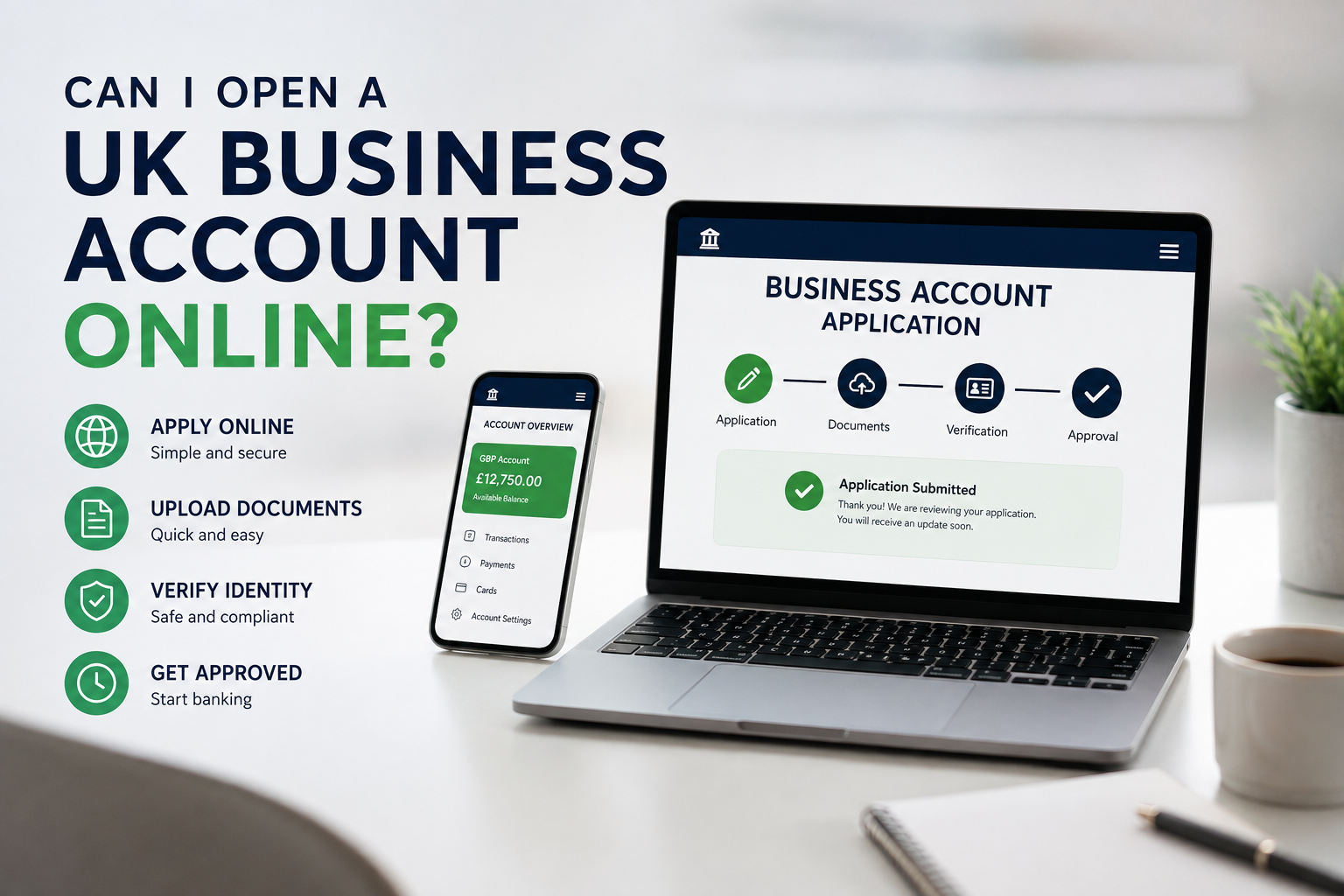
Yes. Many UK e-commerce businesses can apply for and open a business account online, particularly through digital banks and fintech/payment providers. UK government guidance notes that fintech business accounts can be set up online and are generally quicker to establish than traditional bank accounts.
However, online application does not mean automatic approval. The provider will still need to verify the company, its directors and owners, and understand the e-commerce activity.
The process is usually completed digitally without visiting a branch.
A typical application involves:
Apply online → Enter company details → Verify directors → Provide business information → Submit documents → Compliance review → Account decision
Depending on the provider, identity verification may be completed using a smartphone, photograph, selfie or video verification.
Requirements vary between providers, but a UK limited company will typically need to provide information such as:
Business.gov.uk confirms that providers commonly request company registration documents, director information, business addresses and financial information when opening a business account.
E-commerce companies may be asked for more information about how the business operates.
For example:
What do you sell?
Where do you sell?
Where are your customers located?
Which marketplaces do you use?
Which payment processors do you use?
Where are your suppliers located?
Which currencies do you expect to receive?
How much do you expect to process each month?
The provider needs to understand the expected flow of money through the account.
A functioning website can be particularly helpful when applying for an e-commerce business account.
It allows the provider to understand what the company sells and how it operates.
Your website should ideally make important business information easy to find, including:
The information on your website should also be consistent with the information supplied in your account application.
Potentially, yes.
A company does not necessarily need years of trading history before applying for a business account.
Business.gov.uk notes that new businesses may need to apply for a startup account and may be asked for a business plan.
A new e-commerce company may therefore be asked to provide information such as:
Having these ready before applying can reduce avoidable delays.
Potentially.
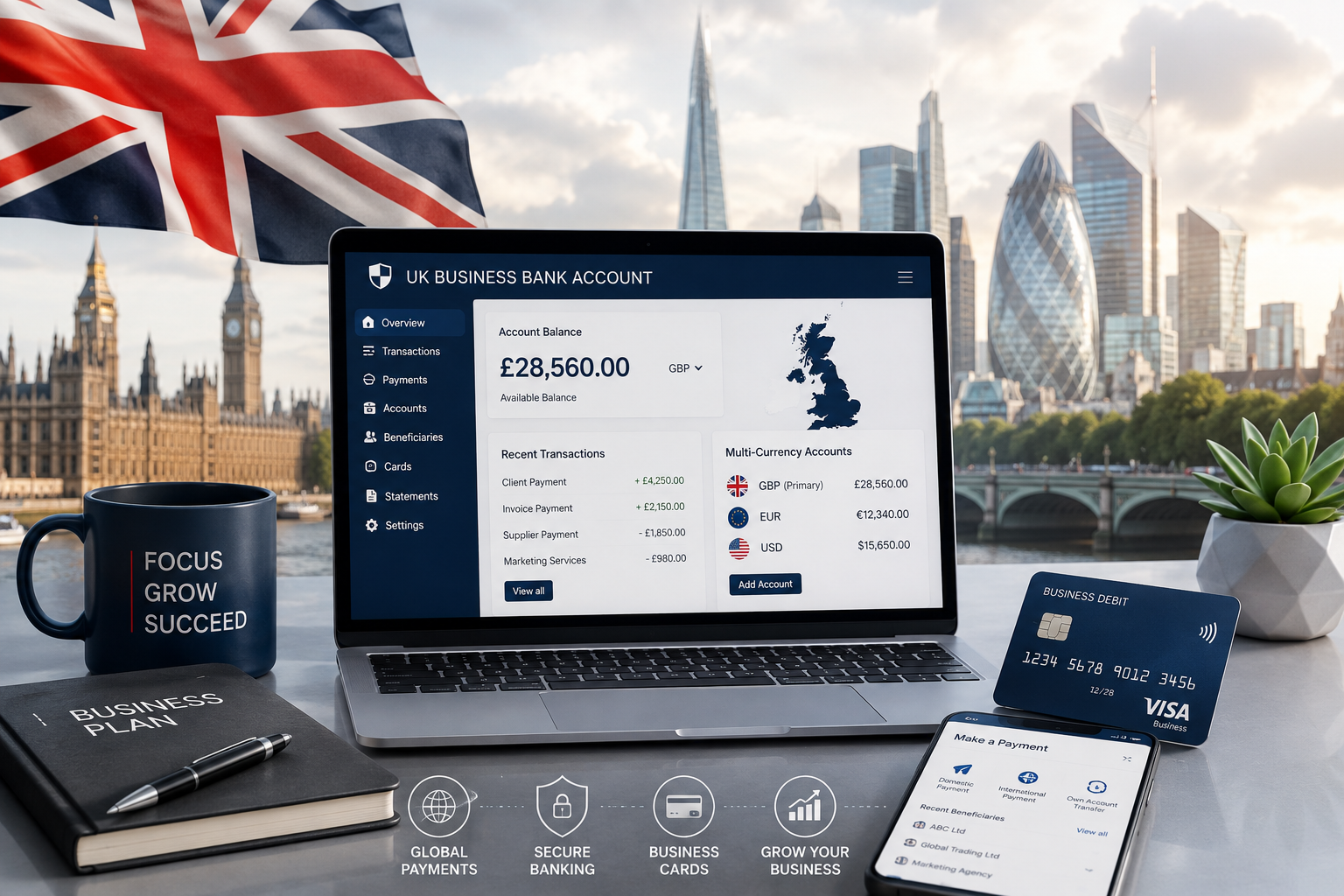
For an international e-commerce business, an online multicurrency business account may be more useful than a standard GBP-only account.
Depending on the provider, the company could potentially manage:
GBP — UK sales and expenses
EUR — European sales and suppliers
USD — US sales and international suppliers
This can be useful if the company sells internationally or pays overseas suppliers.
Potentially, if the account supports those currencies.
For example:
UK sales → GBP
European sales → EUR
US sales → USD
The business could then potentially maintain the currencies separately rather than automatically converting everything into GBP.
Check exactly what the provider means by "multicurrency," because the features available can differ considerably.
Potentially.
Some providers offer eligible UK companies EUR payment details or an IBAN as part of a digital business account.
If your e-commerce company sells in Europe, check whether the account supports:
These features can make managing European sales and suppliers easier.
Potentially.
An international e-commerce business may also benefit from USD payment capabilities.
For example:
Receive USD → Keep USD → Pay USD supplier
or:
Receive USD → Convert USD to GBP
If your company has both USD revenue and USD expenses, maintaining USD may help avoid unnecessary currency conversions.
Potentially, but this should be checked carefully.
Marketplaces establish their own rules regarding which account details sellers can use for payouts.
Before opening an account primarily for marketplace sales, establish whether the marketplace accepts the particular:
Your financial provider accepting e-commerce businesses does not automatically mean every marketplace will accept the account details.
Potentially.
A common e-commerce payment flow is:
Customer → Online checkout → Payment processor → Business account
If your payment processor supports multiple settlement currencies, you may potentially receive:
GBP sales → GBP
EUR sales → EUR
USD sales → USD
This can be particularly useful for international e-commerce businesses.
Usually, provided the account supports the required currencies and destinations.
For example:
Receive GBP → Convert to USD → Pay overseas supplier
or:
Receive USD → Keep USD → Pay supplier in USD
The second scenario can eliminate an unnecessary currency conversion.
For an e-commerce company importing products internationally, foreign exchange costs and international transfer fees can therefore be important when choosing an account.
Potentially.
Dropshipping businesses often have international payment flows, so the provider may want to understand the business model clearly.
You could be asked to provide:
Not every provider supports every business model, so eligibility should be checked before applying.
This depends heavily on the provider.
A UK company can have directors who live overseas, but individual financial institutions set their own residency criteria.
Business.gov.uk says standard UK business bank accounts typically have UK-residency requirements, and international applications can involve additional checks on the company, directors, owners and foreign investors.
Therefore, an overseas director should check:
Does the provider accept non-UK residents?
Is my country of residence supported?
Can verification be completed remotely?
Does the provider support e-commerce businesses?
Does it require a UK trading presence?
These questions should ideally be answered before starting the application.
Not always.
This is where it is important to distinguish between a digital business account and a full traditional UK business bank account.
Current government guidance for international businesses says opening a full UK business bank account can take around 4 weeks to 3 months, and the bank may require a company representative to meet it in the UK to sign a bank mandate.
Digital account providers may offer a much more remote onboarding process.
There is no universal timeframe.
Business.gov.uk says fintech accounts can be set up online in minutes, whereas traditional banks generally take longer.
"Set up online in minutes," however, should not be interpreted as guaranteed approval within minutes.
Your application could take longer if:
The actual timeframe depends on the provider and application.
One of the most common causes is incomplete or inconsistent information.
For example:
Application: Electronics retailer
Website: Clothing store
Expected turnover: £50,000
Expected incoming payments: £500,000
These inconsistencies may require clarification.
Other delays can result from:
Preparing the application carefully can help reduce unnecessary back-and-forth.
Possible reasons include:
A rejection by one provider does not automatically mean another provider will reach the same decision.
A UK limited company is legally separate from its owners.
GOV.UK states that there must be a clear division between the company's finances and those of its owners and directors and specifically says that company banking must be separate from personal banking.
This is particularly useful for e-commerce because a company may process large numbers of:
Keeping these transactions separate also makes accounting and record keeping easier.
Do not choose an account solely because the application is quick.
For an e-commerce business, consider whether it provides:
Business.gov.uk notes that digital providers can work particularly well for businesses wanting integration with digital payment solutions and APIs.
Suppose your business has:
Company: UK limited company
Customers: UK
Sales: GBP
Suppliers: UK
Directors: UK resident
A straightforward online GBP business account may be sufficient.
There may be little need for sophisticated multicurrency facilities.
Now consider:
Company: UK limited company
Customers: UK, Europe and US
Currencies: GBP, EUR and USD
Suppliers: UK, Europe and Asia
The company may benefit from an online multicurrency account supporting:
GBP + EUR + USD + IBAN + SEPA + international transfers + FX
This allows the account structure to match the company's international payment flows.
Potentially, yes. Many digital providers support online applications and remote verification.
Yes, potentially. A new company may be asked for additional information about its business plan, website, products, suppliers and expected transactions.
Digital providers may allow the process to be completed remotely. Traditional banking requirements can differ, particularly for internationally owned companies.
Potentially, but not every provider accepts overseas directors or every country of residence.
Potentially. Some digital business accounts provide multiple currency capabilities.
Potentially, depending on the provider and account features.
Potentially, but check that the marketplace accepts the specific account details before relying on the account for settlements.
No. Every application remains subject to eligibility, identity verification and compliance checks.
Yes, a UK e-commerce business can potentially open a business account entirely online, particularly through digital banks, fintechs and payment providers. Government guidance confirms that fintech business accounts can be set up online and are generally faster to establish than traditional banking arrangements.
For an international e-commerce business, however, speed should not be the only consideration.
The account should match the way your business actually receives and spends money. If you sell across the UK, Europe and the US, look for capabilities such as GBP, EUR and USD, multicurrency balances, an IBAN, SEPA payments, international transfers and competitive currency conversion.
Before applying, make sure the provider supports your e-commerce business model, director residency, marketplaces, payment processors, customer countries and supplier countries. This can help reduce delays and avoid applying for an account that does not match your business.