By

August 21, 2026
Can I Use One Business Account for Multiple Online Stores?
Yes, in many cases you can use one business account for multiple online stores if all the stores are operated by the same legal company.
For example, a UK limited company operating several e-commerce websites or brands may be able to receive their sales proceeds into one company business account.
If one UK company owns several online stores, the payment structure could look like:
Online Store A → Business Account
Online Store B → Business Account
Online Store C → Business Account
This can make it easier to manage the company's cash flow from one place.
Generally, yes.
If the stores are simply different brands or trading names operated by the same limited company, using one business account may be possible.
For example:
ABC Retail Ltd
operates:
Store A
Store B
Store C
All sales ultimately belong to ABC Retail Ltd, so the company may use the same business account, subject to the account provider's terms.
If the stores belong to different legal companies, separate business accounts will usually be more appropriate.
The stores can potentially use different payment processors while settling funds into the same company account.
For example:
Store A → Payment Processor → Business Account
Store B → Payment Processor → Business Account
The payment processor must accept the business account details you provide.
Potentially.
A company selling through several marketplaces may be able to receive payouts into the same account:
Marketplace A → Business Account
Marketplace B → Business Account
Company Website → Business Account
However, each marketplace has its own payout and account-verification requirements.
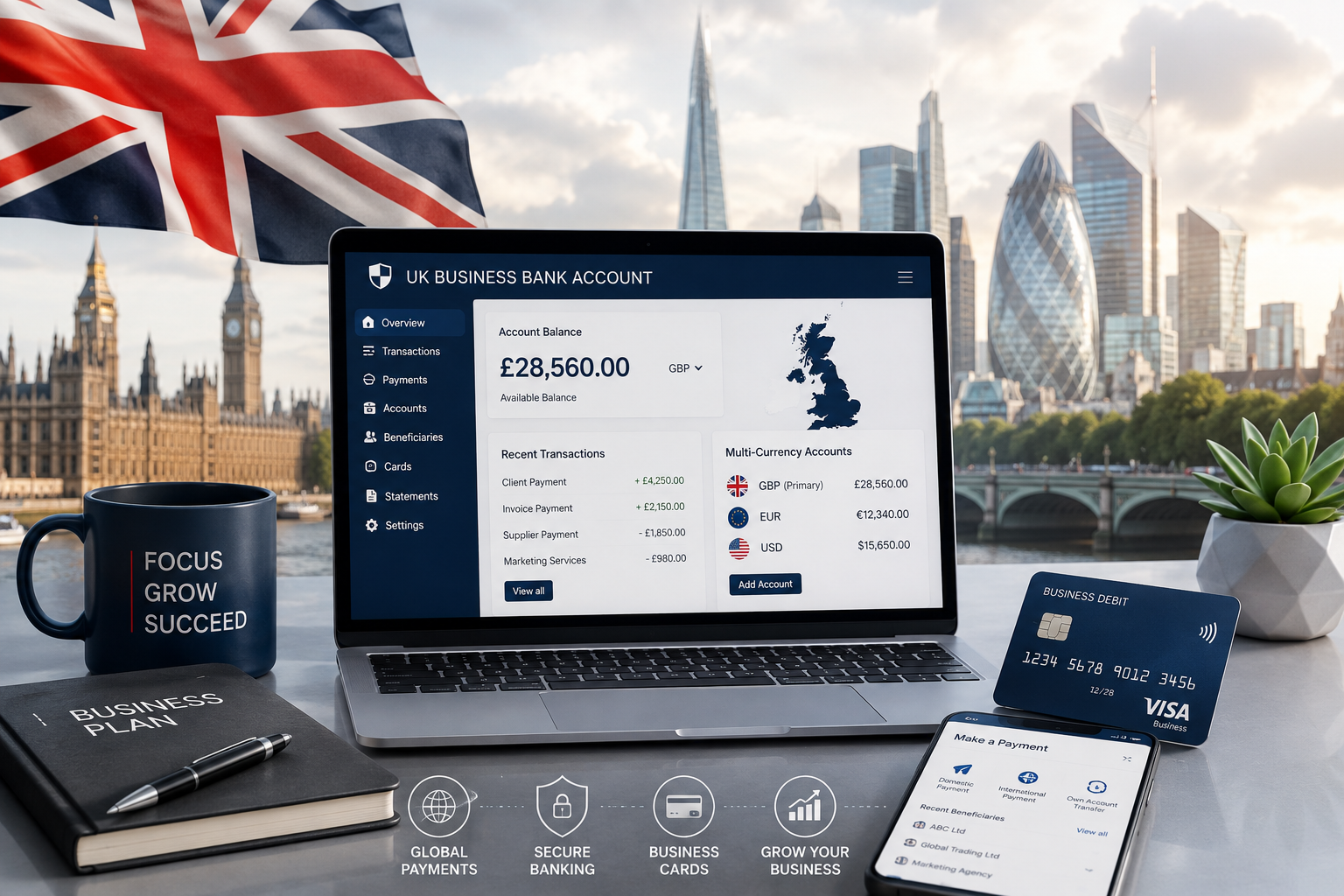
This is where a multicurrency business account can be particularly useful.
For example:
UK Store → GBP
European Store → EUR
US Store → USD
The company could potentially manage all three currencies through the same business account rather than opening separate accounts for each store.
Potentially, if the account supports separate currency balances.
For example:
GBP sales → GBP balance
EUR sales → EUR balance
USD sales → USD balance
The company could then convert currencies when necessary or use them to pay suppliers in the same currency.
This can become an important issue when several stores use the same account.
Good transaction records can help identify:
Store → Payment processor → Settlement → Business account
Some businesses also use separate payment references, currency accounts or virtual IBANs to make reconciliation easier.
Your accounting records should clearly identify which store generated each transaction.
Potentially.
Some business account providers offer Virtual IBANs (vIBANs) that can help separate incoming payment streams.
For example:
Store A → vIBAN 1
Store B → vIBAN 2
Store C → vIBAN 3
The funds may ultimately be managed through the same business account while being easier to identify and reconcile.
Yes.
The provider should have an accurate understanding of your company's activities.
If your company operates several websites, brands or marketplaces, disclose them when requested.
The provider may want to understand:
This is particularly important if the stores sell different types of products.
Separate accounts may be useful if:
For several brands owned by the same company, however, one account may be simpler.
Yes. A limited company can operate multiple websites or trading brands.
Potentially, provided they belong to the same company and the account and payment providers permit it.
Potentially. A multicurrency business account may support all three currencies.
Not necessarily. Multiple websites operated by the same legal company may be able to use the same business account.
Separate business accounts are generally preferable because each company is a separate legal entity and should maintain its own financial records.
Yes, one business account can potentially be used for multiple online stores when they are operated by the same UK company.
For an international e-commerce company operating several stores, a multicurrency business account can make it easier to centralise:
Store A + Store B + Store C → GBP, EUR and USD → One business platform
The key is to maintain clear records for each store and ensure your business account provider, marketplaces and payment processors support the arrangement.