By

August 21, 2026
Do I Need to Live in the UK to Open a UK Business Bank Account?
Not necessarily. You do not always need to live in the UK to open a business account for a UK limited company. However, whether you can open a particular account depends on the bank or payment provider's eligibility requirements.
Many mainstream UK business bank accounts require the applicant or company directors to be UK residents. Other providers may consider UK companies owned or managed by non-UK residents, subject to additional identity, business and compliance checks. UK government guidance acknowledges that overseas businesses and companies with foreign directors or owners can apply for UK banking, although the process may take longer and involve additional checks.
Yes.
You do not have to live in the United Kingdom to be a director of a UK limited company. GOV.UK specifically states that directors do not have to live in the UK, although the company must maintain an appropriate UK registered office address.
This means someone living in Europe, Asia, the Middle East, the United States or another country can potentially establish and manage a UK company.
However, registering the company and opening its business account are two separate processes.
Some do.
Business account eligibility is determined by the individual bank or financial provider.
Business.gov.uk states that applicants can typically only open standard business bank accounts if they are UK residents, but it separately provides guidance for overseas companies and international businesses seeking UK banking facilities.
This means you should not assume that every UK business account is available simply because your company is registered at Companies House.
Some providers may require:
Others may have account products or payment services that accept eligible companies with overseas directors.
Potentially, yes.
If you live outside the UK but are a director of a UK limited company, there may still be account options available.
The provider will normally want to establish:
International ownership can result in more extensive checks than an application involving only UK-resident directors.
Banks and regulated payment providers must carry out identity, anti-money laundering and other compliance checks before providing financial services.
When directors or shareholders are based overseas, additional verification may be necessary.
Business.gov.uk notes that banks opening accounts for overseas businesses conduct additional checks on directors, owners and foreign investors, including identity, security and global database checks.
The director's country of residence can therefore have a significant impact on which account providers are available.
Not necessarily to be a UK company director.
There is an important difference between your personal residential address and your company's registered office address.
A director can live overseas. However, the UK limited company itself must have a qualifying registered office address in the relevant part of the UK.
Individual financial providers may impose additional address requirements when deciding whether to offer an account.
These addresses serve different purposes.
Registered office address: Your company's official address registered with Companies House. It must meet UK registered-office requirements.
Director's residential address: The address where the director actually lives. This can be outside the UK.
Trading address: The location from which the company conducts its business activities.
A financial institution may request information about all three.
Yes, provided the address complies with Companies House requirements.
A company's registered office must be a physical, appropriate address in the relevant UK jurisdiction. GOV.UK also confirms that a company can use an address supplied by an agent, accountant or solicitor with the appropriate permission, provided it meets the requirements.
However, a registered office service does not make you personally a UK resident.
Banks may still ask for proof of your actual overseas residential address.
Every provider has its own requirements, but a non-resident director may commonly need to provide:
For international businesses seeking full UK banking facilities, government guidance says banks may also request a UK business plan explaining why the company requires a UK business bank account.
Not necessarily for every type of business account.
Some digital financial providers support remote applications and online identity verification.
Traditional banking can be different. Business.gov.uk's guidance for international businesses states that opening a full UK business bank account can involve a company representative meeting the bank in the UK to sign the bank mandate.
You should therefore check the specific provider's requirements before applying.
Potentially.
Remote onboarding has made it possible for some financial providers to assess international directors without requiring a branch visit.
The application may involve:
Additional documents may be requested before approval.
Potentially.
A company does not necessarily need years of trading history before applying for a business account.
However, a new company with an overseas director may need to provide more information about its proposed activities.
For example, the provider may ask for:
A clear explanation of how the company intends to operate can make the application easier to assess.
Potentially.
Some providers accept eligible UK companies with overseas directors and provide GBP payment capabilities.
However, availability depends on your country of residence, business sector and company structure.
If you expect to receive payments internationally, you should also consider whether you need EUR or USD facilities rather than focusing exclusively on GBP.
Potentially, and this can be particularly useful for internationally operated UK companies.
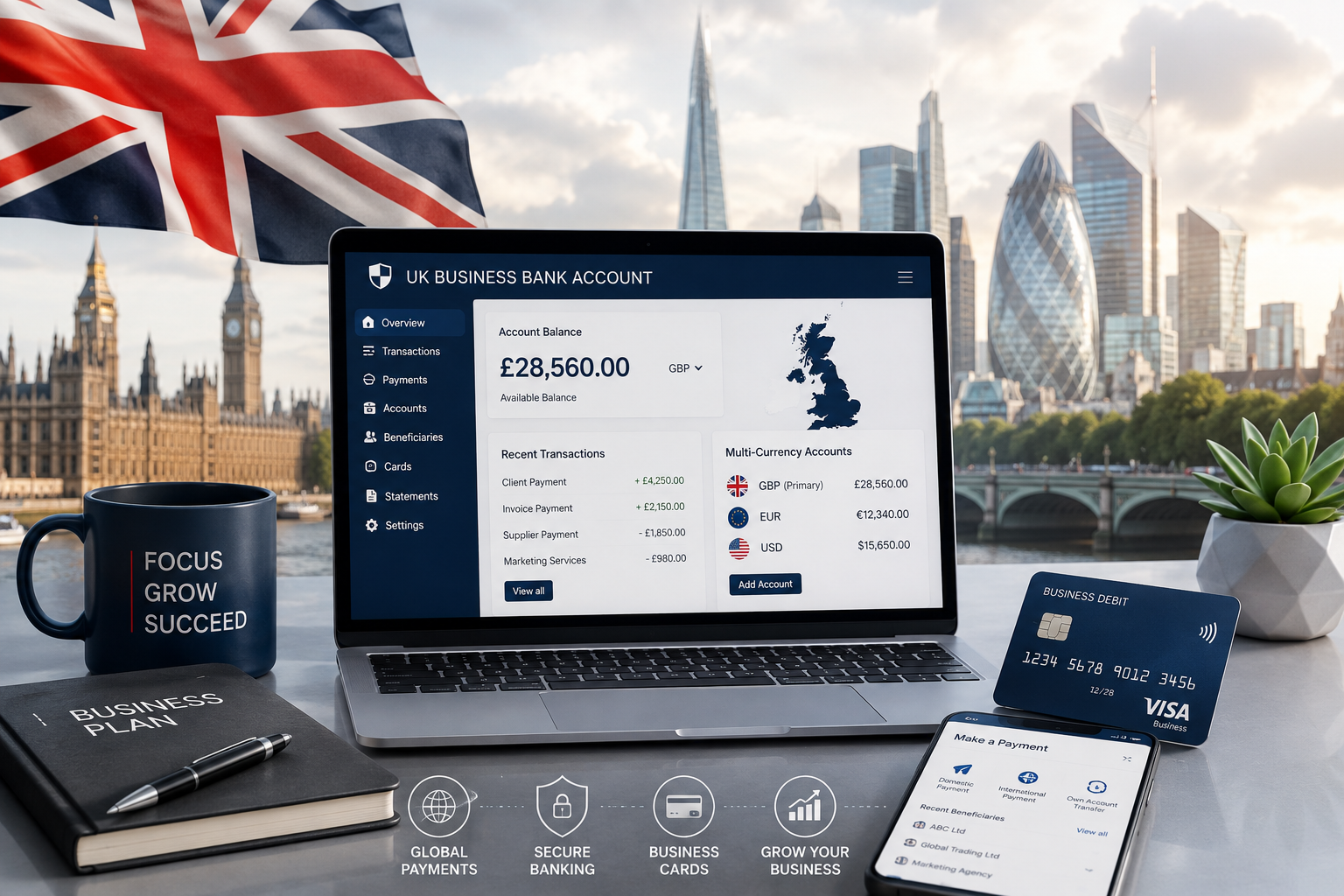
A multicurrency business account may allow an eligible company to manage currencies such as:
GBP — for UK payments
EUR — for European customers and suppliers
USD — for US and international transactions
For example:
Receive EUR → Convert EUR to GBP → Pay UK expenses
or:
Receive USD → Convert USD to EUR → Pay European supplier
Available currencies and payment routes vary by provider.
Potentially.
A UK company may be eligible for EUR payment details even when its director lives outside the UK.
This can be particularly useful for companies receiving payments from European customers.
Businesses should check whether the account supports:
An IBAN alone does not guarantee that all these services are available.
Potentially.
Some regulated financial providers offer Virtual IBANs (vIBANs) to eligible companies.
A virtual IBAN can provide unique payment details connected to underlying account infrastructure.
This can be particularly useful for companies receiving payments from multiple customers because separate virtual IBANs can help identify and reconcile incoming transactions.
Not necessarily, depending on what your business needs.
Business financial services can be provided by different types of regulated institutions, including banks, electronic money institutions and payment institutions.
These are not necessarily equivalent products.
Before applying, check:
The best option depends on how your company intends to use the account.
A limited company is legally separate from its owners and directors.
GOV.UK states that there must be a clear division between company finances and the finances of owners and directors, and specifically says that company banking must be separate from personal banking.
Maintaining separate company finances also makes it easier to track:
Account approval is never guaranteed.
Potential problems include:
Providing accurate information and supporting documents from the beginning can reduce unnecessary delays.
Make sure you can clearly explain what your company does and why it needs the account.
Be prepared to demonstrate:
Business activity — What products or services does the company provide?
Customers — Who pays the company and where are they located?
Suppliers — Who does the company pay and in which countries?
Currencies — Will you receive GBP, EUR, USD or other currencies?
Transaction volumes — How much do you realistically expect to receive and send?
Source of funds — Where does the company's money originate?
A simple, transparent business model supported by appropriate documentation is generally easier for a financial institution to assess.
No. UK company directors do not have to live in the UK.
Not always. Many standard accounts have UK-residency requirements, but options may exist for eligible UK companies with overseas directors.
Not to be a company director, but individual account providers may have their own residency and address requirements.
Yes. A UK limited company must maintain an appropriate registered office address in the relevant UK jurisdiction.
Potentially. Some providers support remote onboarding, while other banking arrangements can require an in-person meeting.
Potentially. Multicurrency account providers may offer these currencies to eligible UK companies.
No. Company registration and business-account approval are separate processes.
You do not necessarily need to live in the UK to operate a UK limited company or obtain business payment facilities. UK company directors are permitted to live overseas, but individual banks and payment providers can set their own residency and eligibility requirements.
For a non-UK resident director, the key is finding an account provider that supports your country of residence, business activity, ownership structure and expected transactions.
Internationally operated UK companies may also benefit from considering multicurrency business accounts with GBP, EUR and USD capabilities, SEPA payments, international transfers and currency conversion, rather than limiting the search to a traditional GBP-only bank account.