By

August 21, 2026
Does an E-Commerce Business Need a Business Bank Account?
Whether an e-commerce business needs a business bank account depends largely on its legal structure. If your online business operates through a UK limited company, company finances should be kept separate from your personal finances. If you operate as a sole trader, the legal position is different, although a separate business account can still make managing online sales considerably easier.
For an e-commerce company receiving payments from online stores, marketplaces or payment processors, a dedicated business account can help manage sales revenue, supplier payments, advertising costs, refunds and international transactions.
A UK limited company is a separate legal entity from its directors and shareholders.
This means company money should be kept separate from personal money. GOV.UK states that there must be a clear division between the finances of a limited company and those of its owners and directors, including separate banking arrangements.
For an e-commerce limited company, this means customer revenue and company expenses should be managed separately from the director's personal finances.
This makes it easier to identify:
A dedicated business account provides a practical way to maintain that separation.
The situation is different for sole traders.
A sole trader and their business are not separate legal entities in the same way as a limited company and its directors.
However, opening a separate business account can still be beneficial.
Keeping online business transactions separate can make it easier to:
You should also check the terms of your personal bank account, as some personal accounts may restrict or prohibit business use.
Online businesses can generate a large number of transactions.
Money may arrive from several different sources while expenses are paid to multiple suppliers and service providers.
For example:
Online store → Payment processor → Business account
Marketplace → Business account
Business account → Product supplier
Business account → Shipping company
Business account → Advertising platform
Keeping all these transactions in a dedicated account makes the company's financial activity easier to understand and reconcile.
For a limited company, company and personal finances should be kept separate.
Even for a sole trader, using one personal account for both personal and e-commerce transactions can quickly become difficult to manage.
Imagine receiving hundreds of customer-related payments while also using the same account for groceries, rent and personal subscriptions.
Determining which transactions belong to the business becomes unnecessarily complicated.
A separate account creates a much clearer financial record.
You can prepare and build an online business before opening its financial account, but it is generally sensible to establish appropriate business payment arrangements before significant trading begins.
Your business may need an account to:
Setting up the account early can help avoid mixing company and personal transactions.
Yes, subject to the requirements of the payment processor and account provider.
When customers purchase products online, the money may first be processed by a card or payment service.
The payment flow might look like:
Customer → Online checkout → Payment processor → Business account
The payment processor typically collects the customer's payment and later settles funds to the nominated business account.
Generally, yes, subject to the marketplace's verification and payout requirements.
An e-commerce company selling through multiple marketplaces could potentially receive settlements into its business account.
For example:
Marketplace A → Business account
Marketplace B → Business account
Website payment processor → Business account
This allows the company to centralise its sales revenue.
Businesses should check that the particular account details they intend to use are accepted by each marketplace.
International e-commerce businesses often have more complex banking requirements.
A UK online company might:
In this situation, a basic GBP-only account may not necessarily be the most efficient option.
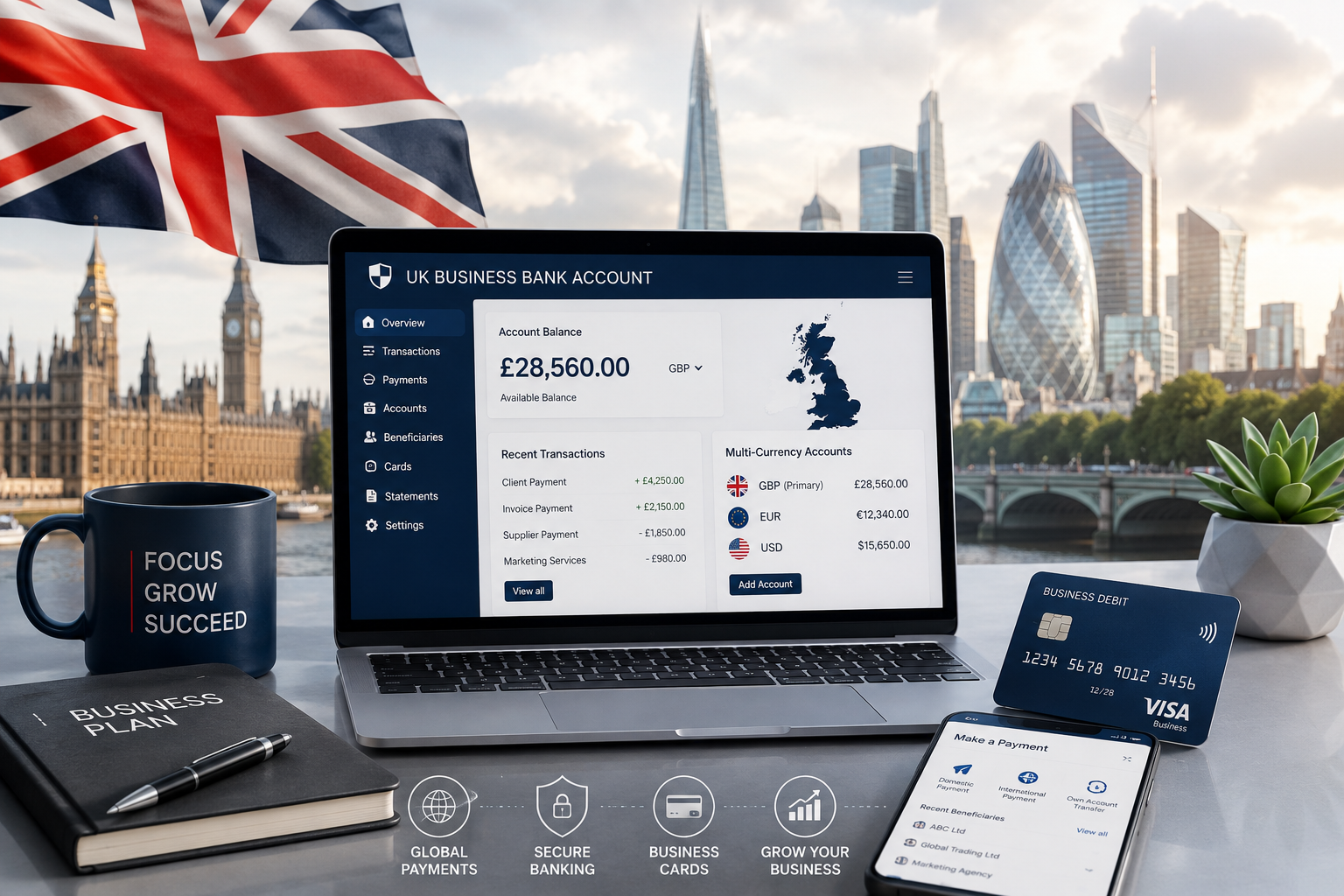
A multicurrency business account may provide greater flexibility.
A multicurrency account allows an eligible business to manage several supported currencies.
For example:
GBP — UK sales and expenses
EUR — European customers and suppliers
USD — US sales and international suppliers
Instead of automatically converting every foreign-currency payment into GBP, the business may be able to maintain funds in the original currency.
This can be useful when the company has both income and expenses in the same currency.
Potentially, if your business account supports EUR.
For example:
Receive EUR → Keep EUR → Pay European supplier
or:
Receive EUR → Convert EUR to GBP → Pay UK expenses
Businesses receiving regular euro payments may also want to check whether their account provides an IBAN and SEPA payment capabilities.
Potentially.
USD capabilities can be useful for e-commerce businesses selling internationally or receiving settlements denominated in US dollars.
For example:
Receive USD → Keep USD → Pay USD supplier
or:
Receive USD → Convert USD to GBP
This can help avoid unnecessary currency conversions where the company has both USD income and USD expenses.
Yes, provided the account supports the relevant country, currency and payment method.
International supplier payments are common in e-commerce.
For example:
Receive GBP → Convert GBP to USD → Pay overseas supplier
or:
Receive EUR → Convert EUR to USD → Pay manufacturer
When choosing an account, consider:
These factors can have a significant impact on an international e-commerce business.
Foreign exchange can become a substantial cost for an online business operating internationally.
Imagine a company receives USD from customers, automatically converts the funds into GBP and then converts GBP back into USD to pay a supplier.
That creates two currency conversions.
Where an account allows the business to maintain USD, it may instead be possible to:
Receive USD → Keep USD → Pay supplier in USD
Whether this is appropriate depends on the company's payment requirements and the services offered by its provider.
A dropshipping business operating through a limited company should keep its company finances separate from the director's personal finances.
Dropshipping can involve particularly international payment flows.
For example:
Customer → Online store → Payment processor → Business account → Overseas supplier
The company may also pay for:
A dedicated business account makes these transactions easier to track.
If the marketplace operation is conducted through a limited company, maintaining separate company finances is important.
A business account can also help marketplace sellers organise:
If you sell through several marketplaces, having one central account can provide a clearer overview of the company's cash flow.
Potentially.
A newly incorporated company does not necessarily need an established trading history before applying.
However, because the company has limited historical information, the account provider may request details about its proposed activities.
This could include:
A complete and professional website can help demonstrate the intended nature of the business.
Potentially.
UK limited companies can have directors who live overseas, but individual banks and payment providers establish their own residency requirements.
A non-resident director may need to provide:
Some providers accept internationally operated UK companies, while others require UK-resident applicants.
Potentially.
A business account may provide an IBAN for receiving supported payments.
This can be useful for online companies receiving bank transfers from customers, marketplaces or other businesses.
If the company trades in Europe, it may also be worth checking whether the account supports EUR and SEPA payments.
Potentially.
Some financial providers offer Virtual IBANs (vIBANs) to eligible businesses.
Virtual IBANs can help companies separate and identify different incoming payment streams.
For example, separate virtual IBANs could potentially be allocated to:
This can make payment reconciliation easier for businesses processing large numbers of transfers.
The right features depend on where the business sells and how it gets paid.
An international e-commerce business may want to consider:
Account fees and foreign exchange costs should also be compared.
A business account and payment processor perform different functions.
A payment processor typically handles customer payments at checkout.
The business account receives and manages the company's funds.
For example:
Customer pays by card → Payment processor processes transaction → Funds are settled into business account
An e-commerce company may therefore need both.
Requirements vary, but a limited company may be asked for:
Existing businesses may also need to provide evidence of previous trading activity.
It depends on the legal structure and the provider's terms. Limited companies should keep company finances separate from personal finances, while sole traders may still find a separate business account highly beneficial.
For a limited company, company and personal finances should be kept separate. Sole traders should check whether their personal account permits business transactions.
A dedicated company account is the practical way to keep the limited company's transactions separate from the director's personal finances.
Generally, yes, provided the marketplace accepts and verifies the account details.
Potentially. Some multicurrency business accounts support several currencies for eligible businesses.
Not necessarily. However, it can be useful if your business regularly receives foreign currencies or pays international suppliers.
Potentially. New businesses may need to provide a website, supplier details, business information and expected transaction volumes.
Potentially. Eligibility depends on the provider's residency, country, business-sector and compliance requirements.
An e-commerce business operating through a UK limited company should keep its company finances separate from the personal finances of its directors and shareholders. A dedicated business account is one of the simplest ways to achieve this while keeping online sales, supplier payments and operating expenses organised.
For an international e-commerce company, the account may need to do considerably more than simply receive GBP.
Businesses selling across multiple markets should consider whether they need GBP, EUR and USD capabilities, multicurrency balances, an IBAN, SEPA payments, international transfers and currency conversion.
Choosing an account that matches where your customers, marketplaces and suppliers are located can make managing an international e-commerce business considerably more efficient.