By

August 24, 2026
How Can a UK Company Collect Payments in GBP, EUR and USD?
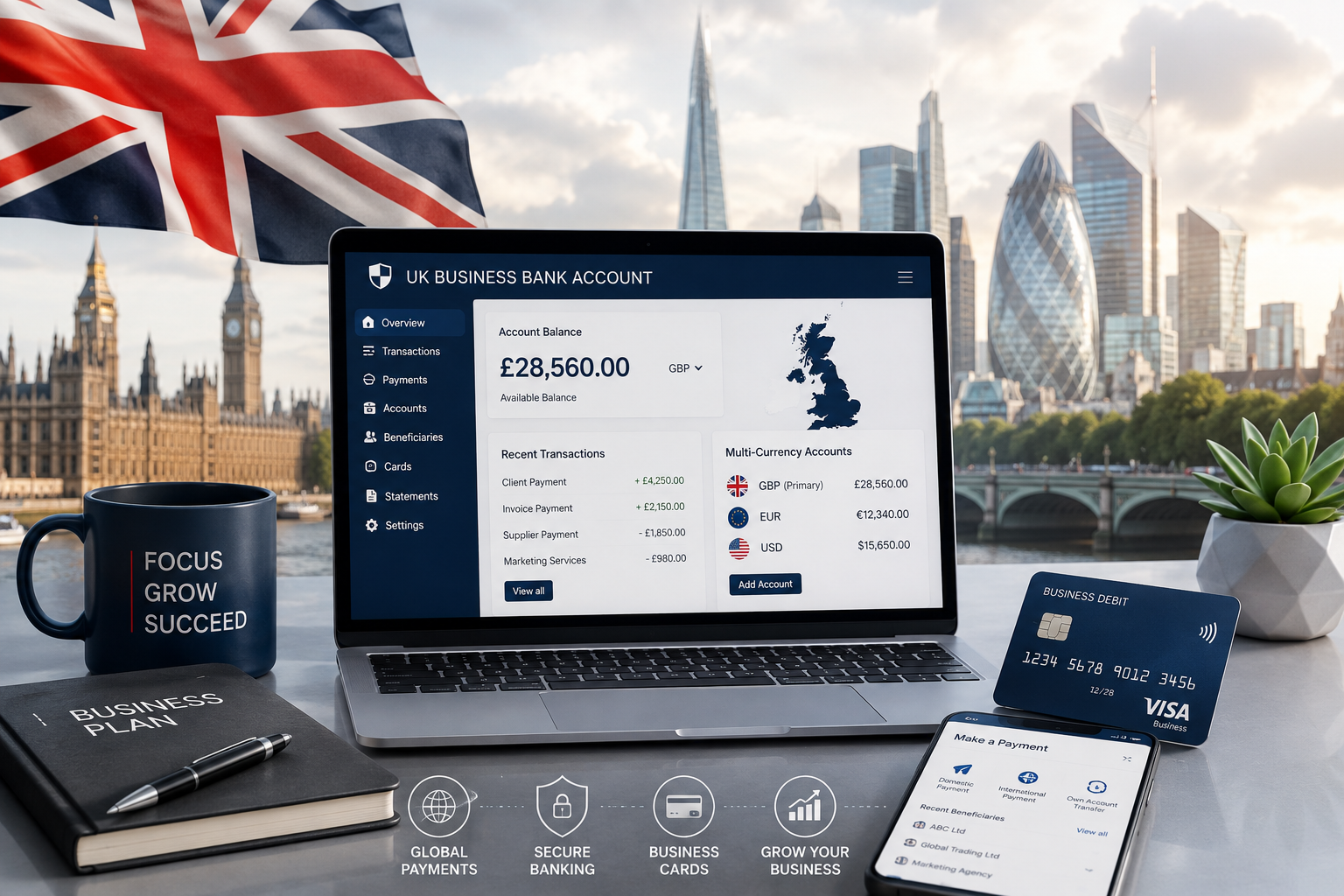
A UK limited company can collect payments in GBP, EUR and USD by using a business account or payment arrangement that supports multiple currencies.
Instead of requiring every international customer to pay in pounds sterling, the company can invoice customers in their preferred currency and, where its account supports it, receive and hold those currencies separately.
A typical setup could be:
UK customers → GBP
European customers → EUR
US customers → USD
This can be particularly useful for UK companies selling internationally.
Yes.
UK companies can invoice customers in foreign currencies. HMRC confirms that businesses can invoice for goods and services in any currency, although relevant amounts must be converted into sterling for UK VAT purposes where applicable.
The practical question is whether the company's chosen bank or payment provider supports receiving and holding the currencies it needs.
A multicurrency business account allows a company to receive, hold, send or convert more than one currency, depending on the provider.
For example, the company might maintain:
GBP balance: £25,000
EUR balance: €18,000
USD balance: $40,000
Rather than automatically converting every payment into GBP, the company may be able to keep the funds in their original currency until they are needed.
For GBP payments, the company can provide customers with its GBP payment details.
For example:
Customer invoice: £5,000
The invoice might contain:
The customer sends £5,000 and the company receives GBP.
This is particularly straightforward for UK customers paying by bank transfer.
If the company's payment arrangement supports EUR, it can invoice European or other customers in euros.
For example:
Invoice: €10,000
The company provides the appropriate EUR receiving instructions, which may include an IBAN and other details depending on the account and payment route.
The payment flow could be:
European customer → €10,000 → Company's EUR balance
The company could then potentially hold the EUR, convert it into GBP or use it for EUR expenses.
The same principle applies to US dollars.
A UK company could issue:
Invoice: $20,000 USD
and provide the appropriate USD payment instructions supplied by its financial provider.
The resulting payment could be:
US customer → $20,000 → Company's USD balance
Whether the customer can use a domestic US transfer or needs an international transfer depends on the receiving details provided by the company's account provider.
Not necessarily.
One option is to maintain separate accounts with different providers.
Another is to use one multicurrency business account that supports GBP, EUR and USD balances.
Conceptually:
UK Limited Company
↓
Multicurrency Business Account
↙ ↓ ↘
GBP | EUR | USD
The exact account details, payment networks, fees and functionality vary between providers.
The main advantage is flexibility.
Suppose your company has customers in three markets:
UK customer: £10,000
German customer: €15,000
US customer: $25,000
If you require everyone to pay in GBP, overseas customers may have to convert their currency before making payment.
Alternatively, your company could invoice each customer in a familiar currency.
UK government export guidance notes that invoicing customers in their own currency can sometimes make a UK business more competitive internationally, although doing so also exposes the seller to exchange-rate risk.
Potentially, yes, if its business account supports foreign-currency balances.
For example:
Customer pays $50,000
Instead of:
$50,000 → Automatically convert to GBP
the company could potentially:
Receive USD → Hold USD → Convert later
This can give the company greater control over when currency conversion takes place.
Potentially, and this can be one of the main benefits of holding multiple currencies.
Imagine the company receives:
$100,000 from US customers
and needs to pay:
$60,000 to US suppliers
Without a USD balance, the money could potentially undergo:
USD → GBP → USD
creating two currency conversions.
With suitable multicurrency facilities, the company may instead be able to:
Receive $100,000 → Hold USD → Pay supplier $60,000 → Convert remaining USD when needed
This can reduce unnecessary conversions, although transfer and account fees may still apply.
Government export guidance specifically identifies receiving money into a foreign-currency account as one way businesses can manage exchange-rate exposure.
The same strategy can work with euros.
For example:
EU customers → €50,000
EU suppliers → €30,000
The company could potentially use part of its EUR receipts to meet EUR expenses and convert only the amount it needs in GBP.
This is sometimes referred to as a form of natural hedging, because income and expenses in the same currency partly offset one another.
Yes.
International bank transfers are particularly common for larger B2B transactions. UK government export guidance describes international bank transfers as the most common export payment method for B2B transactions, especially larger ones.
The customer may need:
Always use the receiving instructions supplied for the specific currency.
Potentially, yes.
An online company can use an appropriate payment processor to accept international card payments.
For example:
UK customer → Pays £100
EU customer → Pays €100
US customer → Pays $100
The payment processor then settles the funds according to the company's account configuration.
However, accepting a customer's currency does not necessarily mean the company will receive settlement in that same currency. Some payment arrangements automatically convert settlements.
Check the processor's:
before deciding on a setup.
Yes.
An international e-commerce business might display different currencies depending on the customer's market.
For example:
UK website visitor → GBP
European visitor → EUR
US visitor → USD
The customer pays through the online checkout, and the payment processor handles the transaction.
Whether the business ultimately receives GBP, EUR or USD depends on its payment-processing and settlement setup.
An international invoice should clearly state the payment currency.
For example:
Invoice total: $5,000 USD
Currency: USD
Payment terms: 14 days
Payment method: Bank transfer
Payment reference: INV-1005
For international trade, UK government guidance recommends having clear written terms stating the amount due, currency, payment timing and responsibility for bank charges.
Yes.
HMRC states that a business can invoice in any currency.
So a UK company can issue:
Invoice 001 → £5,000 GBP
Invoice 002 → €7,500 EUR
Invoice 003 → $12,000 USD
However, foreign-currency transactions still need to be dealt with correctly for accounting and tax purposes.
If UK VAT applies, foreign-currency invoicing does not remove the company's VAT obligations.
HMRC requires relevant foreign-currency amounts to be converted into sterling for VAT accounting. Where UK VAT is due, the required VAT information must also be shown in sterling.
This means:
Customer payment currency: EUR
does not necessarily mean:
VAT accounting currency: EUR.
A UK company should maintain the appropriate sterling records for VAT purposes.
Foreign-currency transactions also need to be properly reflected in the company's accounting records.
HMRC's corporate finance guidance explains that foreign-currency transactions are generally translated using the exchange rate applicable at the transaction date, subject to the accounting rules being applied.
Foreign-exchange gains or losses may also arise as exchange rates change.
Before choosing a multicurrency payment setup, look beyond the headline account fee.
Consider:
A provider advertising a low transfer fee could still be expensive if its exchange-rate spread is high.
A practical approach is to match income and expenses where possible.
For example:
GBP customers → GBP expenses
EUR customers → EUR suppliers
USD customers → USD suppliers
Then convert only the surplus currency that the business actually needs elsewhere.
For an international company, the flow could therefore become:
Collect → Hold → Pay → Convert when required
rather than:
Collect → Immediately convert everything to GBP → Convert back when foreign currency is needed.
A company receiving substantial international payments may benefit from a structure such as:
UK Limited Company
↓
Multicurrency Business Account
↓
GBP | EUR | USD
↓
Receive customer payments
↓
Hold currencies
↓
Pay suppliers
↓
Convert surplus funds when required
The right setup depends on transaction volumes, customer locations, supplier currencies, payment methods and fees.
Yes, provided its banking or payment arrangements support receiving those currencies.
Not necessarily. A multicurrency business account may support several currency balances within one overall account relationship.
Yes. HMRC permits businesses to invoice in foreign currencies.
Yes. The same foreign-currency invoicing rules apply, with the appropriate VAT treatment where relevant.
Not necessarily. If the company's account supports holding USD or EUR, it may be possible to retain the original currency.
Potentially, yes. If the account supports outgoing payments in that currency, the company may be able to use its USD or EUR balance directly.
A UK company can collect payments in GBP, EUR and USD by using banking and payment facilities that support multiple currencies.
A simple structure is:
UK customers → GBP → GBP balance
European customers → EUR → EUR balance
US customers → USD → USD balance
The company can then potentially hold each currency, pay expenses in the same currency and convert funds into GBP or another currency only when required.
For internationally trading UK companies, this can make customer payments simpler and help reduce unnecessary currency conversions. The company must still maintain appropriate accounting records and follow UK VAT rules when foreign-currency transactions are involved.