By

August 21, 2026
How Can a UK E-Commerce Business Receive International Payments?
A UK e-commerce business can receive international payments through payment processors, online marketplaces, international bank transfers and multicurrency business accounts.
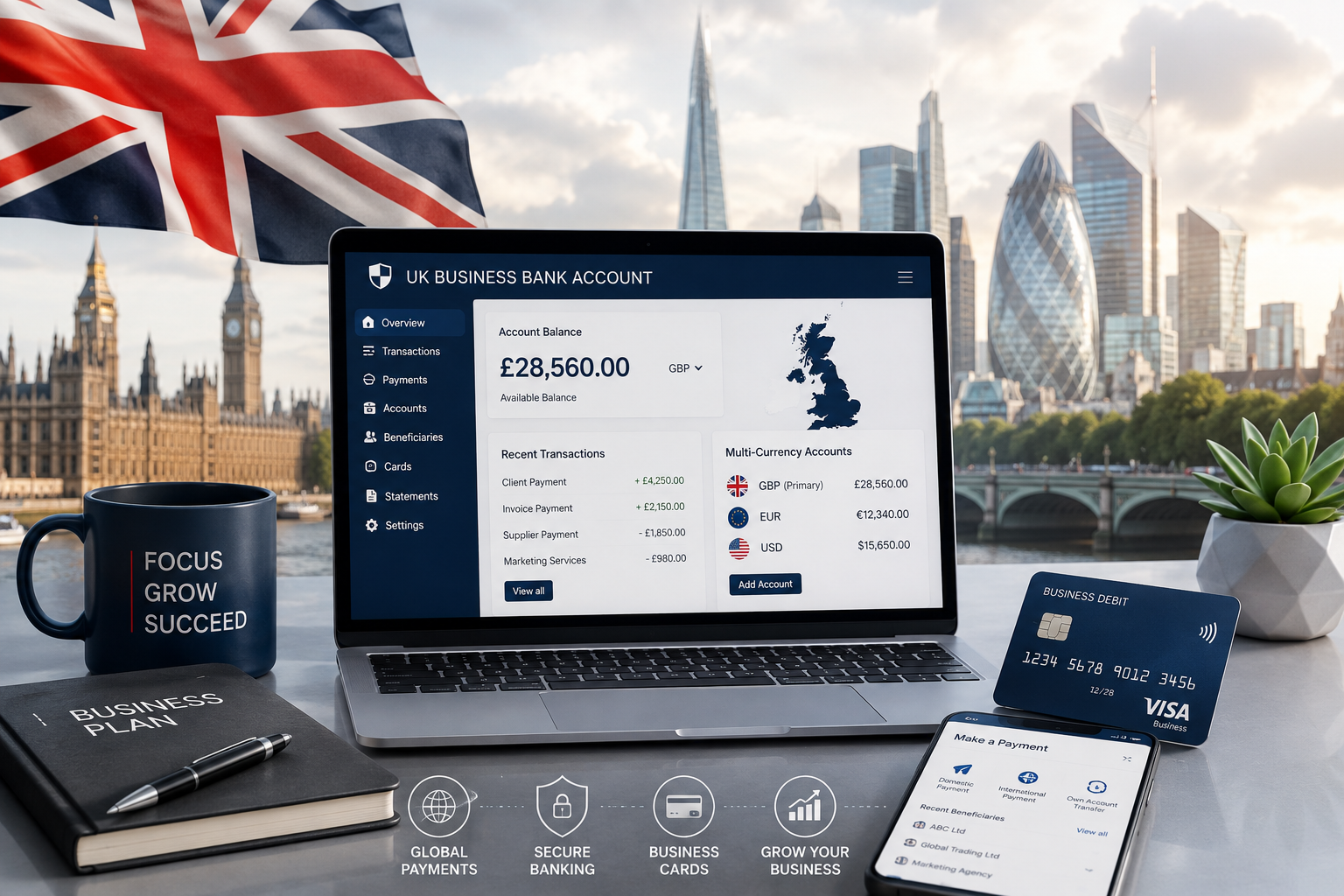
For businesses selling across the UK, Europe, the United States and other markets, a multicurrency setup can be particularly useful because it may allow the company to receive GBP, EUR and USD, keep funds in those currencies, convert them when required and pay international suppliers.
UK government guidance recommends adapting e-commerce payment methods to local markets because customers often prefer familiar payment methods and their local currency.
A typical international e-commerce payment starts when an overseas customer purchases a product through your website or marketplace.
For example:
Customer → Online checkout → Payment processor → UK company's business account
Alternatively:
International customer → Bank transfer → UK company's business account
For marketplace sales:
Customer → Marketplace → Marketplace payout → UK company's business account
The exact payment route depends on where you sell and how customers pay.
A UK e-commerce company can generally receive international revenue through several methods.
Credit and debit cards are one of the most important payment methods for online retail.
A customer might purchase a product from your UK company while living in another country.
For example:
US customer pays $150 → Payment processor → Business receives settlement
The settlement currency depends on your payment processor and business-account setup.
Government export guidance identifies card payments and digital payment services as common methods for e-commerce transactions.
Payment processors connect your online checkout with the financial system.
A typical transaction could look like:
Customer pays online → Processor handles transaction → Funds settled to business account
The processor may convert the payment automatically or, depending on its capabilities, settle it in the original currency.
For an international e-commerce company, this distinction can be important.
If your business sells through online marketplaces, the marketplace may collect the customer's payment and later send the sales proceeds to your nominated business account.
For example:
Marketplace UK sales → GBP
Marketplace European sales → EUR
Marketplace US sales → USD
Actual payout currencies and accepted account details depend on the marketplace.
International bank transfers are particularly relevant for e-commerce businesses that also make B2B sales.
Government export guidance describes international bank transfers as the most common payment method for B2B export transactions, particularly for larger payments.
A customer could receive an invoice containing your company's payment details and transfer the funds directly.
Potentially, yes.
A suitable multicurrency business account could allow the company to manage:
GBP — UK customers and expenses
EUR — European customers and suppliers
USD — US customers and international suppliers
This can be particularly useful for businesses operating across several markets.
A multicurrency business account allows a company to manage more than one supported currency.
Rather than receiving every international payment and immediately converting it into GBP, the business may be able to maintain separate balances.
For example:
GBP sales → GBP balance
EUR sales → EUR balance
USD sales → USD balance
The company can then decide whether to spend, transfer or convert those funds.
Government guidance specifically suggests that businesses with significant international activity may need accounts in different currencies, particularly when they also need to pay suppliers in those currencies.
Making it easy for international customers to pay can improve the checkout experience.
A customer in the United States may prefer:
$99 USD
rather than seeing a price only in GBP.
Similarly, a European customer may prefer:
€89 EUR
rather than having to calculate the equivalent pound value.
UK government guidance says customers in different markets are likely to want to pay in their local currency and recommends adapting payment methods to local buying behaviour.
These are not necessarily the same thing.
Suppose a US customer buys a product for $100.
Your checkout may show:
Customer pays $100 USD
But your payment processor could then:
Convert USD → GBP → Deposit GBP into your business account
Alternatively, where your processor and account support USD settlement:
Customer pays $100 USD → Business receives USD
For businesses with significant international sales, the second arrangement can provide more control over currency conversion.
A UK e-commerce company may be able to receive EUR through a suitable multicurrency account.
For example:
European customer → EUR → Company's EUR balance
The company could then:
Keep EUR → Pay European supplier
or:
Convert EUR → GBP
If your business regularly receives euro bank transfers, you may also want an account providing an IBAN and SEPA payment capabilities.
SEPA is an important payment framework for euro-denominated transfers.
For an e-commerce business trading with Europe, suitable SEPA capabilities can make it easier to receive and send EUR payments.
For example:
European business customer → SEPA EUR transfer → Company's EUR account
The company might then use the EUR to pay European suppliers without first converting the funds into GBP.
A suitable business account may also allow your UK company to receive USD.
For example:
US customer → USD → Company's USD balance
The business could then potentially:
Keep USD → Pay USD supplier
or:
Convert USD → GBP
The exact USD payment details available depend on the financial provider.
Yes, where the account and payment network support the transfer.
Government export guidance notes that international bank transfers are widely used for B2B transactions and that businesses need to provide buyers with the correct payment information, which can include an IBAN.
An IBAN can therefore be particularly useful for e-commerce businesses that also invoice wholesale or other business customers.
Potentially.
Some financial providers offer Virtual IBANs (vIBANs) to eligible companies.
A virtual IBAN can help identify and reconcile incoming payments.
For example, an e-commerce company could potentially allocate payment details according to:
Marketplace A → vIBAN 1
Marketplace B → vIBAN 2
Wholesale customers → vIBAN 3
Online Store → vIBAN 4
Incoming funds can then be easier to identify and reconcile.
Potentially.
International marketplace sellers may receive payouts from different markets or marketplace entities.
However, you should confirm:
Marketplace requirements can change independently of your business account provider.
Yes.
Your website normally requires a payment gateway or processor capable of accepting your customers' preferred payment methods.
Government guidance recommends ensuring that the payment gateway supports the payment options used in your target market and notes that allowing customers to check out in their local currency can reduce cart abandonment.
Your setup might therefore look like:
UK visitor → GBP checkout
European visitor → EUR checkout
US visitor → USD checkout
The processor then settles the funds according to your account configuration.
Not necessarily.
For businesses with occasional international sales, converting foreign revenue into GBP may be simpler.
But for companies with significant international revenue and expenses, maintaining foreign currencies can be useful. Government guidance specifically identifies receiving payment into a foreign-currency account as one way businesses can manage exchange-rate exposure.
Consider a company receiving $50,000 in USD while needing to pay a supplier $30,000 in USD.
Automatically converting everything could result in:
Receive $50,000 → Convert USD to GBP → Convert GBP back to USD → Pay $30,000 supplier
A multicurrency arrangement could potentially allow:
Receive $50,000 → Keep USD → Pay $30,000 supplier → Convert remaining $20,000 if required
This can avoid an unnecessary conversion.
Very important for businesses processing significant international volumes.
Exchange rates change continually, and currency movements can affect margins. Government export guidance recommends considering the currency in which customers are invoiced and factoring currency-conversion costs and exchange-rate risk into pricing.
An e-commerce company should therefore compare:
Do not judge an account solely by its monthly subscription price.
Potentially.
This is one of the major advantages of a multicurrency business account.
For example:
Receive GBP → Pay UK supplier
Receive EUR → Pay European supplier
Receive USD → Pay international supplier
If you already have sufficient funds in the supplier's currency, you may avoid converting money solely to make the payment.
UK e-commerce companies frequently source products internationally.
Depending on the supplier's preferred currency, the business could potentially:
Receive USD → Pay supplier in USD
or:
Receive GBP → Convert GBP to USD → Pay supplier
Before making international supplier payments, check:
It depends on the customer and market.
Government export guidance says GBP can reduce exchange-rate risk for UK companies, but invoicing in the buyer's currency can sometimes make the business more competitive. USD and EUR are specifically identified as common foreign invoicing currencies.
For B2C e-commerce, local-currency pricing can also improve the customer's shopping experience.
For B2B e-commerce or wholesale sales, invoices should clearly specify the agreed payment terms and currency.
UK government guidance on export invoices says commercial invoices should include information such as the unit price, payment method and currency.
Depending on the payment method, you may also need to provide the appropriate account or IBAN details separately.
An e-commerce company should choose its payment infrastructure based on its actual international sales and supplier flows.
Important features can include:
The best setup depends on where your customers and suppliers are located.
Imagine a UK company with:
UK sales: £40,000 per month
European sales: €30,000 per month
US sales: $50,000 per month
Its expenses include:
UK expenses: £25,000
European supplier: €20,000
International supplier: $30,000
A multicurrency setup could potentially allow:
GBP revenue → GBP expenses
EUR revenue → EUR supplier
USD revenue → USD supplier
Only surplus funds would need to be converted where necessary.
This can make international cash flow considerably easier to manage.
Potentially, yes.
The company will need appropriate business banking and payment-processing arrangements.
An account provider may request information such as:
Business.gov.uk notes that business account providers typically request company, director, address and financial information when assessing an application.
Potentially.
The company's ability to receive international payments depends on whether its account and payment providers accept its ownership structure, directors' countries of residence, business activity and transaction profile.
Internationally managed UK companies may therefore want to establish eligibility before applying.
Common methods include card payments, payment processors, marketplace payouts and international bank transfers.
Potentially. A multicurrency business account may allow eligible companies to manage all three currencies.
Not necessarily. If international sales are occasional and most expenses are in GBP, a standard business account may be sufficient. A multicurrency account becomes more useful when foreign-currency revenue and expenses are significant.
Potentially. Your checkout and payment processor must support the customer's currency. Offering local-currency checkout can make international purchasing easier.
Potentially. The account must provide suitable EUR payment details and support the relevant transfers.
Potentially, if your business account supports maintaining a USD balance.
Potentially. This can help avoid unnecessary currency conversions where revenue and expenses are in the same currency.
Yes. GOV.UK states that a limited company's banking must be separate from the personal banking of its owners and directors.
A UK e-commerce business can receive international payments through card processors, marketplaces, bank transfers and multicurrency business accounts.
For businesses selling internationally, an effective payment structure can be:
Customer pays → Receive currency → Keep or convert → Pay suppliers
A company selling across the UK, Europe and the US may therefore benefit from being able to receive GBP, EUR and USD, maintain separate currency balances, access an IBAN and SEPA payments, make international transfers and convert currencies when necessary.
The most important consideration is to match your payment setup to your actual business: where customers are located, how they prefer to pay, which currencies you receive, and where and how you pay your suppliers.