By

August 21, 2026
How Long Does It Take an Overseas Director to Open a UK Business Bank Account?
Opening a UK business bank account as an overseas director can take anywhere from a relatively short digital onboarding process to several weeks or even months, depending on the provider and complexity of the application.
For a full traditional UK business bank account involving international directors or owners, current UK government guidance says the process can take approximately 4 weeks to 3 months, allowing time for meetings, verification checks and approval.
Digital business account providers can sometimes have much faster onboarding processes, although approval is never guaranteed. Business.gov.uk notes that fintech accounts can be set up online and are generally quicker to establish than traditional bank accounts.
A UK limited company is allowed to have directors who live outside the United Kingdom. GOV.UK confirms that directors do not have to live in the UK, although the company must maintain a UK registered office address.
However, overseas directors can create additional verification requirements during account opening.
According to Business.gov.uk, banks may conduct additional checks where a company has foreign investors, directors or owners. These can include:
These additional checks are one reason an international application can take longer than a straightforward domestic application.
For an international business applying for a full UK business bank account, government guidance currently suggests allowing:
Approximately 4 weeks to 3 months.
This timeframe can include gathering documents, arranging any required meetings, completing compliance checks and waiting for final approval.
More complex companies may take longer, particularly where additional information is requested.
Digital financial providers can sometimes process applications considerably faster.
Business.gov.uk describes fintech business accounts as being capable of online setup and notes that they can be quicker and easier to establish than traditional high-street banking arrangements.
However, an overseas director should not assume that an advertised fast onboarding time applies to every application.
A provider may still need additional time if:
The actual approval time therefore depends on the individual application.
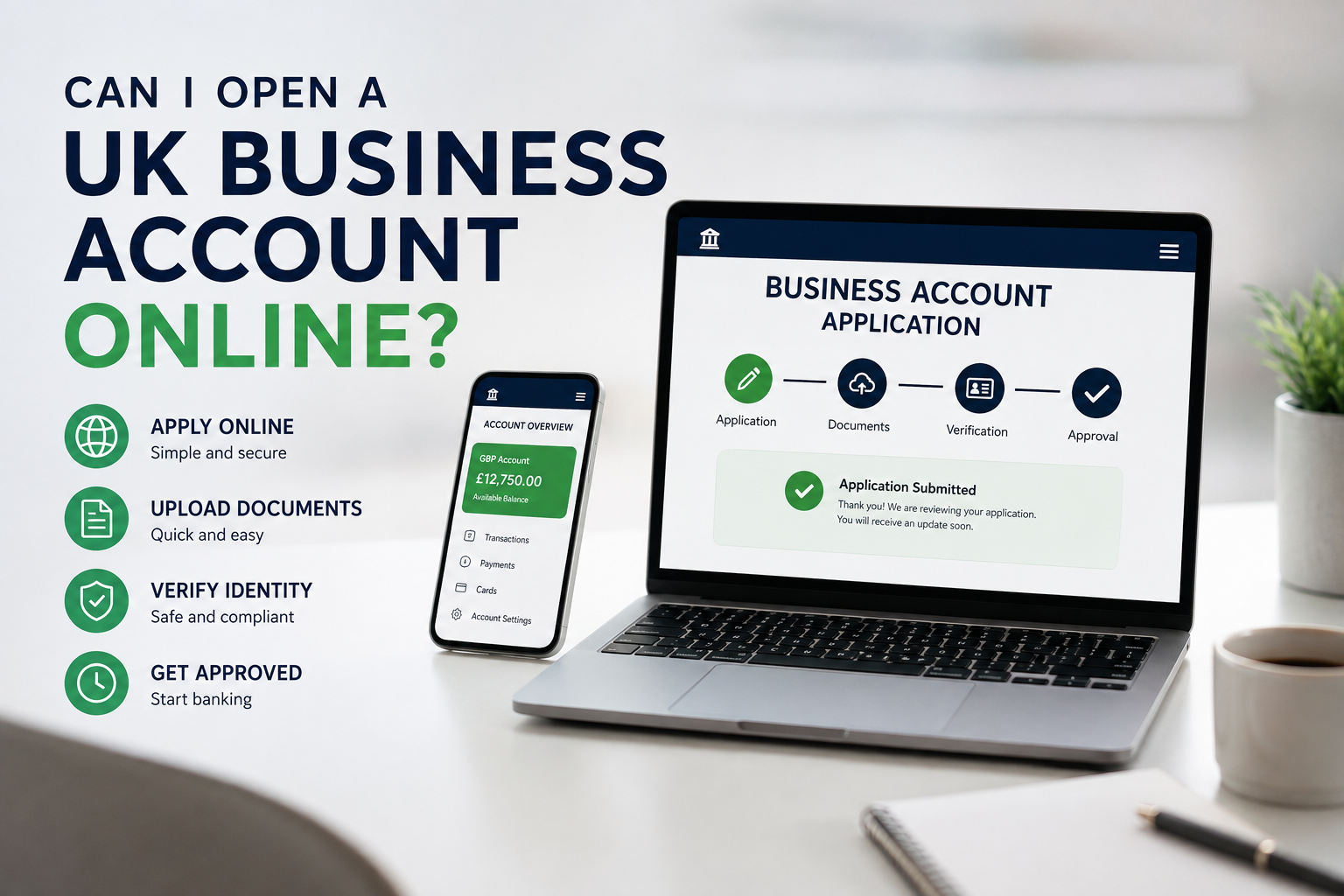
An overseas director's application generally involves several stages.
The provider will normally verify the UK company and its registration details.
This can include checking:
Information should be consistent with Companies House records.
The overseas director will normally need to prove their identity.
This could involve providing:
Remote verification may be available depending on the provider.
The provider may need to verify the director's actual overseas residential address.
Documents could include an accepted:
Requirements vary between providers.
The financial institution needs to understand who ultimately owns and controls the company.
Information may be required for:
Complex ownership structures can significantly increase the time required for onboarding.
The provider will also need to understand what the company actually does.
You may be asked to explain:
Clear and complete answers can help avoid unnecessary requests for clarification.
Preparing documents before applying can make the process more efficient.
Depending on the provider, you may need:
For international businesses applying for a full UK business bank account, Business.gov.uk says institutions will generally require proof of UK company registration, proof of a UK business address, identification information and a UK business plan explaining why the account is required.
Several factors can extend the application process.
Missing or expired documents can result in additional requests.
The provider may require additional time to verify foreign documents.
Companies with multiple shareholders, corporate shareholders or several layers of ownership can require more extensive checks.
If the provider cannot clearly understand what the company does, it may request further information.
Additional evidence may be required to demonstrate where the company's funds originate.
Businesses expecting payments from or to multiple countries may require additional compliance review.
Large expected payments may require more detailed information about customers, suppliers and commercial activity.
This depends on the provider.
Digital financial providers may support remote onboarding.
For international businesses seeking a full traditional UK business bank account, current Business.gov.uk guidance states that the bank may need to meet at least one company representative in the UK to sign the bank mandate.
If a UK visit is required, arranging the meeting can add additional time to the application.
Potentially.
Some financial providers offer remote onboarding, allowing directors to submit documents and complete identity verification online.
However, not every provider accepts non-UK resident directors.
Before applying, check whether the provider specifically supports:
UK company + overseas director + your country of residence + remote onboarding
Checking eligibility before beginning an application can save considerable time.
Not necessarily, but a new company may require additional supporting information.
A newly incorporated company does not have historical financial statements or an established transaction history.
The provider may therefore ask for:
Business.gov.uk notes that new businesses may need to provide a business plan when applying for a business account.
It can.
Each director, shareholder or beneficial owner may need to be identified and verified.
For example:
1 director + 1 shareholder
may be easier to verify than:
4 directors + 5 shareholders + corporate shareholder + multiple countries
The more complex the ownership structure, the more information the provider may need to review.
Potentially, depending on the provider.
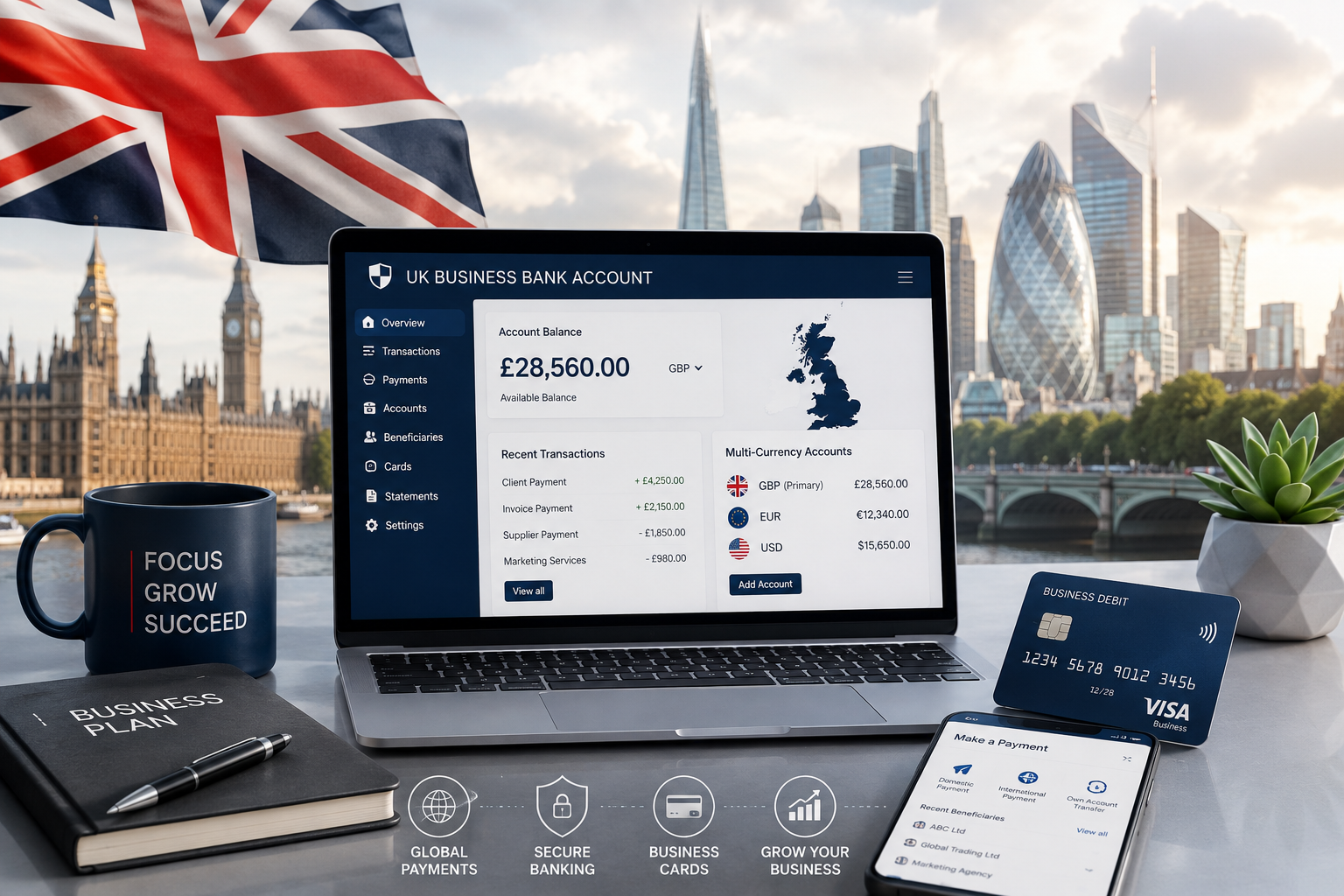
Internationally operated UK companies may also consider regulated payment or fintech providers offering multicurrency business accounts.
Business.gov.uk notes that fintech accounts are generally quicker to establish than traditional banking arrangements, although the range of services can differ.
Depending on the provider, a multicurrency account may offer capabilities for:
GBP — UK transactions
EUR — European transactions
USD — US and international transactions
Eligibility and approval times still depend on the company and its directors.
Potentially.
Some financial providers may offer eligible UK companies EUR payment details or an IBAN.
If your company receives payments from Europe, check whether the account supports:
The availability of these services depends on the provider rather than simply the fact that the company is incorporated in the UK.
Potentially.
Some providers offer Virtual IBANs (vIBANs) to eligible businesses.
Virtual IBANs can be useful for companies receiving payments from multiple customers because they can help identify and reconcile incoming transactions.
Applications remain subject to the provider's KYC, KYB and compliance requirements.
One of the most effective ways to avoid delays is to prepare everything before applying.
Make sure you can clearly explain:
What does the company do?
Provide a specific description of the company's products or services.
Where are the customers?
Identify the main countries from which payments will originate.
Where are the suppliers?
Explain where the company expects to send funds.
Which currencies are required?
For example, GBP, EUR and USD.
What is the expected turnover?
Provide a realistic estimate.
What transaction volumes are expected?
Estimate monthly incoming and outgoing transactions.
What is the source of funds?
Have supporting evidence available where appropriate.
Consistency can also help reduce unnecessary questions.
For example:
Companies House: Software development company
Website: Software development services
Application: Software development services for UK and European businesses
Invoices: Software development
These provide a consistent explanation of the business.
By contrast, an application describing software development when the company's website appears to operate an unrelated e-commerce business may trigger additional questions.
Before making multiple applications, it is usually better to establish whether each provider actually supports your circumstances.
Check:
Applying to unsuitable providers can waste time without improving your chances of approval.
There is no universal timeframe. For a full UK business bank account involving an international business, current UK government guidance suggests allowing approximately 4 weeks to 3 months.
Potentially. Digital fintech accounts can generally be quicker to establish than traditional bank accounts, although international applications may still require additional compliance checks.
The provider may need to carry out additional checks relating to your identity, residential address, company ownership and international activities.
No. GOV.UK confirms that directors do not have to live in the UK, although the company must have a UK registered office.
Potentially, depending on the provider. Some digital providers support remote onboarding, while a full traditional banking arrangement may involve an in-person meeting.
No. Complete documentation can help prevent avoidable delays, but the provider may still need to carry out compliance checks or request additional information.
No. The 4-week-to-3-month period is government guidance for planning purposes, not an approval guarantee or statutory deadline.
An overseas director should generally expect a UK business account application to take longer than a straightforward UK-resident application. For a full traditional UK business bank account involving international ownership, current government guidance recommends allowing approximately 4 weeks to 3 months for the process.
Digital financial providers can sometimes offer faster onboarding, but approval depends on the director's country of residence, company ownership, business activity, source of funds and expected transactions.
Preparing your identification, company documents, business plan, customer and supplier information, expected transaction volumes and source-of-funds evidence before applying can help reduce avoidable delays.
For an internationally operated UK company, it is also worth considering what the business actually needs from its account—such as GBP, EUR and USD capabilities, a EUR IBAN, SEPA payments, international transfers and currency conversion—rather than choosing an account based solely on how quickly it can be opened.