By

August 24, 2026
How Long Does KYC Verification Take for a UK Company?
There is no fixed legal timeframe for KYC verification for a UK limited company. How long it takes depends on the bank or payment provider, the company's ownership structure, the documents provided and whether additional checks are required.
A straightforward application may be verified relatively quickly, while a more complex UK company application can take several days or longer, particularly if the provider requests additional information.
UK rules generally require relevant customer and beneficial-owner identity checks to be completed before the business relationship is established, subject to limited exceptions.
KYC stands for Know Your Customer. For companies, the process is also sometimes described as KYB — Know Your Business.
When a UK company applies for a business bank account or payment service, the provider may need to verify:
Customer due diligence also involves understanding the purpose and intended nature of the business relationship.
There is no universal processing time.
For a straightforward UK limited company with simple ownership and complete documentation, verification may sometimes be completed quickly.
More complex cases may take:
Several days → Additional review → Further documents → Final decision
The important distinction is that KYC verification time and total business account approval time are not necessarily the same thing.
A provider may complete identity verification but still need to assess the company's business activities and overall eligibility.
Verification is generally easier when the company has:
Providing everything requested at the beginning can reduce the need for follow-up questions.
Several issues can extend the process.
If the provider requests a passport, proof of address or company document and it is missing, verification may stop until the information is supplied.
For example:
Application: Director lives in Spain
Proof of address: Shows an old German address
The provider may need clarification or updated documentation.
A simple structure such as:
Individual → 100% → UK Limited Company
is generally easier to understand than a company owned through several corporate entities.
The provider may need to identify and verify the ultimate beneficial owners.
Potentially, although not necessarily.
A UK limited company can have non-UK resident directors, but an overseas director may require additional verification depending on the provider.
This can include:
The provider may also have its own eligibility restrictions concerning particular countries.
Potentially.
A UK company receiving or sending international payments may be asked about:
For example, a UK company receiving USD from US customers and paying overseas suppliers may require a more detailed review than a small business operating entirely within the UK.
Yes.
A provider may request evidence showing where company funds originated.
For example:
Customer contract → Invoice → Customer payment → Company account
or:
Director's savings → Director funding → Company account
If the provider cannot clearly establish the source of funds, it may request additional documents.
Some applications require Enhanced Due Diligence (EDD) because they present a higher assessed money-laundering or terrorist-financing risk.
EDD can involve additional measures concerning identity, source of funds, business purpose and ongoing monitoring.
This can naturally make the verification process longer.
Potentially.
Many providers use digital verification systems that allow directors to:
Current UK guidance allows qualifying digital verification services to be used for customer due diligence under the Money Laundering Regulations.
However, automated verification does not guarantee instant account approval.
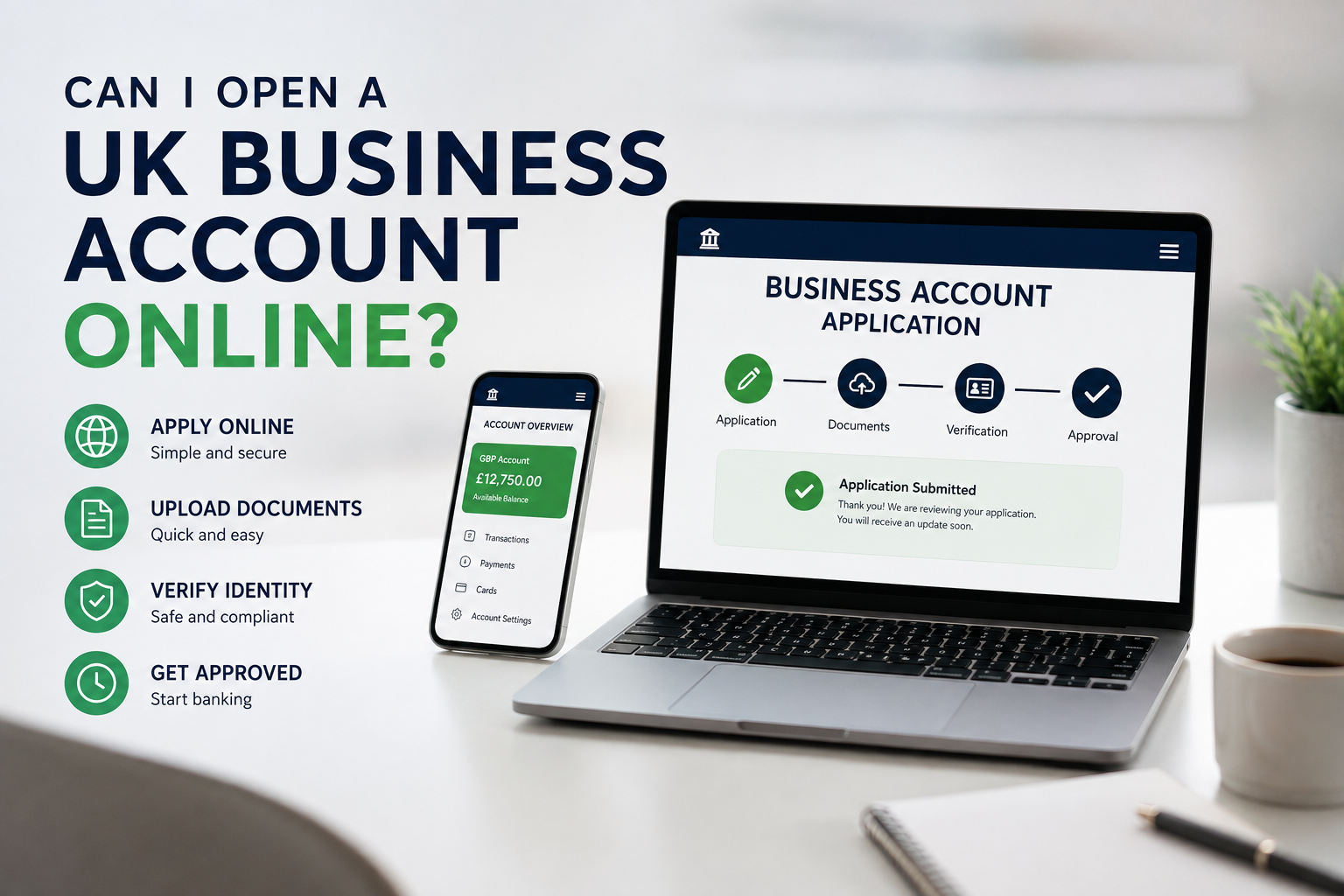
A typical UK company KYC process might look like:
1. Application submitted
You provide information about the company.
2. Company checked
The provider verifies company information and may check Companies House.
3. Directors verified
Identification and residential addresses are checked.
4. Beneficial owners checked
The provider establishes who ultimately owns or controls the company.
5. Business reviewed
The company's activities and intended use of the account are assessed.
6. Additional documents requested
Invoices, contracts, bank statements or source-of-funds evidence may be required.
7. Final review
The provider decides whether it can establish the business relationship.
A pending application does not necessarily mean it will be rejected.
It may mean the provider is:
The time required depends heavily on the circumstances of the application.
You cannot control the provider's review time, but you can reduce avoidable delays.
Before applying, prepare:
Make sure the information is accurate and consistent.
No.
Financial providers have ongoing monitoring obligations and may review customer information, beneficial ownership and transactions throughout the relationship.
A UK company may therefore be asked for updated KYC documents even after its account has been operating for years.
No.
Since 18 November 2025, Companies House identity verification requirements have been introduced with a 12-month transition period for existing directors and PSCs.
Companies House verification and a bank's KYC process are separate.
Completing one does not automatically mean you have completed the other.
There is no standard timeframe. Straightforward cases may be completed quickly, while applications requiring manual or enhanced review can take several days or longer.
Common reasons include missing documents, overseas directors, complex ownership, source-of-funds checks or additional due diligence.
It can, particularly if overseas documents or additional geographic checks are required, but being a non-UK resident does not automatically mean verification will be slow.
Often, yes. Many providers use digital identity and document-verification processes.
No. The provider may still need to complete eligibility, compliance and risk assessments before approving the account.
Yes. Customer due diligence can continue throughout the business relationship, particularly when information or circumstances change.
There is no fixed timeframe for KYC verification for a UK company. A straightforward application with simple ownership and complete documentation may be processed quickly, while more complex cases can take several days or longer.
The process is usually faster when you provide valid identification, current proof of address, clear ownership information, a straightforward explanation of the business, realistic expected account activity and source-of-funds evidence where required.
Most importantly, remember that completing KYC does not necessarily mean the business account has been approved. KYC is one part of the provider's wider onboarding, eligibility and risk-assessment process.