By

August 21, 2026
What Type of Business Bank Account Is Best for an E-Commerce Company?
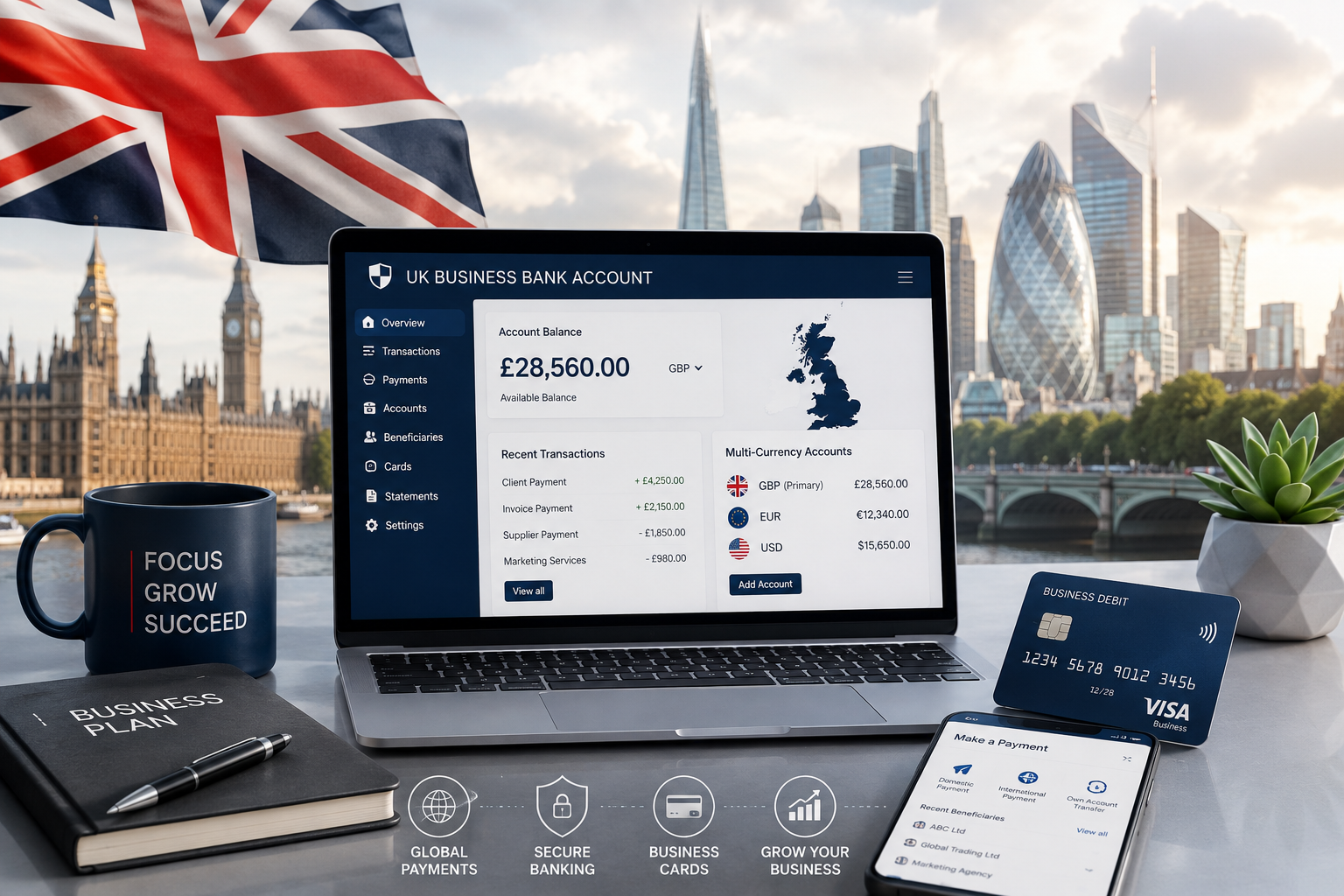
For many e-commerce companies, the best business account is one that supports online payments, marketplace payouts, multiple currencies, international supplier payments and competitive currency conversion.
A UK e-commerce business selling internationally may benefit from a multicurrency business account that can manage currencies such as GBP, EUR and USD rather than relying solely on a traditional GBP account.
The right choice ultimately depends on where your customers are located, how you receive sales revenue, which marketplaces you use, where your suppliers are based and which currencies you regularly receive and pay.
An e-commerce company can have very different banking requirements from a traditional local business.
A local company might primarily receive GBP and pay UK suppliers. An online business could receive payments from several countries while paying suppliers, advertising platforms and logistics companies internationally.
Typical requirements include:
The importance of each feature depends on the business model.
For an e-commerce business that trades internationally, a multicurrency account can be one of the most useful options.
It allows an eligible company to manage several currencies without necessarily converting every incoming payment immediately.
For example:
GBP — UK customers and expenses
EUR — European customers and suppliers
USD — US sales and international suppliers
This can make international cash flow easier to manage.
Consider a UK e-commerce company that sells internationally.
It might:
Receive GBP from UK sales.
Receive EUR from European sales.
Receive USD from international sales or marketplaces.
At the same time, it might pay:
GBP to UK service providers.
EUR to European logistics companies.
USD to overseas suppliers.
A GBP-only account could require frequent currency conversion.
A multicurrency account may provide more control over when and how those conversions happen.
Potentially.
Imagine your company receives $20,000 in USD sales revenue and needs to pay a supplier $12,000 in USD.
If the sales revenue is automatically converted:
USD → GBP
and you later need to pay the supplier:
GBP → USD
the company has converted the money twice.
If the account allows you to maintain USD, the payment flow could instead be:
Receive USD → Keep USD → Pay supplier in USD
The company can then convert only the remaining funds if necessary.
Actual savings depend on the provider's exchange rates, fees and payment charges.
For a UK e-commerce company, GBP capabilities will usually be important.
GBP may be required for:
If the company primarily operates in the UK, a straightforward GBP business account may be sufficient.
If the company sells to European customers or pays European suppliers, EUR capabilities can be valuable.
For example:
Receive EUR → Keep EUR → Pay EUR supplier
or:
Receive EUR → Convert EUR to GBP
Businesses dealing regularly in euros may also want access to an IBAN and SEPA payment capabilities.
USD can be particularly useful for international e-commerce businesses.
A company may receive USD from international sales while also paying manufacturers, software companies or other suppliers in USD.
For example:
Receive USD → Keep USD → Pay USD supplier
This can be more efficient than automatically converting every USD payment into GBP.
Marketplace sellers should look for a business account that is compatible with their sales channels.
Important considerations include:
Before opening an account specifically for marketplace payouts, confirm that the marketplace accepts the type of account details provided.
Marketplace rules can change independently of your business account provider.
A company selling through its own website should consider how customer payments reach the business.
A common payment flow is:
Customer → Online checkout → Payment processor → Business account
The business account should therefore be compatible with the payment processors the company uses.
It should also support the currencies in which the processor settles funds.
If the payment processor settles GBP, EUR and USD separately, a multicurrency account may be particularly useful.
Dropshipping companies often have international payment flows.
For example:
Customer pays online → Payment processor → Business account → Overseas supplier
A dropshipping business may therefore benefit from:
The account provider must also support the company's business model and countries of operation.
An e-commerce company importing physical products may regularly pay overseas manufacturers and wholesalers.
For example:
UK sales in GBP → Convert GBP to USD → Pay supplier
or:
European sales in EUR → Convert EUR to USD → Pay supplier
For these businesses, international transfer and foreign exchange costs can become particularly important.
When comparing accounts, consider both the advertised transfer fee and the cost of currency conversion.
If the company receives or sends euro payments, having suitable IBAN details can be useful.
An IBAN can allow customers, businesses or payment partners to identify the account when making supported bank transfers.
For European e-commerce activity, also check whether the provider supports SEPA transfers.
An IBAN by itself does not guarantee access to every European payment service.
Some providers offer Virtual IBANs (vIBANs) to eligible businesses.
Virtual IBANs can be useful for companies receiving many incoming bank transfers because separate payment details can help identify the origin or purpose of payments.
For example, an e-commerce company might potentially use different virtual IBANs for:
Marketplace A
Marketplace B
Online Store A
Online Store B
The exact functionality depends on the provider.
If your e-commerce company regularly trades in Europe, SEPA capabilities can be important.
SEPA is widely used for euro-denominated bank transfers across participating countries.
An e-commerce company might use SEPA to:
If Europe is a significant market for your company, check SEPA support before opening the account.
For international e-commerce, usually yes.
Your company may need to send money to:
Check which countries and currencies the account supports.
Potentially very important.
Small differences in foreign exchange costs can become significant as transaction volumes increase.
Suppose an e-commerce company converts £1 million equivalent per year.
Even a difference of 0.5% in the effective conversion cost represents:
£5,000 per year.
Therefore, do not compare accounts solely on monthly subscription fees.
Also examine:
The total cost matters more than any single advertised fee.
Not necessarily.
A free business account is not automatically the cheapest option.
For example, Account A might have no monthly subscription but relatively expensive international transfers and currency conversion.
Account B might charge a monthly fee but provide more competitive FX pricing.
For a domestic e-commerce company with very few transactions, Account A could be cheaper.
For an international company processing significant foreign-currency volumes, Account B could potentially cost less overall.
Compare costs based on your actual expected transactions.
Transaction limits can be important for growing online businesses.
Check whether the provider places limits on:
An account suitable for a startup processing £5,000 per month may not necessarily be suitable when turnover reaches £500,000 per month.
They can be useful for managing e-commerce expenses.
A company card could be used for:
Companies with employees may also benefit from multiple cards with separate spending limits.
Potentially.
Virtual business cards can help separate different categories of online spending.
For example:
Card 1 → Advertising
Card 2 → Software
Card 3 → Shipping
Card 4 → Subscriptions
This can make expense management and reconciliation easier.
Availability depends on the account provider.
Yes.
E-commerce companies can generate large numbers of transactions.
The ability to download account activity can therefore be important.
Useful formats may include:
Good reporting makes it easier to reconcile marketplace payouts, supplier payments and operating expenses.
Integration can be useful for businesses processing significant numbers of transactions.
Depending on the account, transactions may be synchronised with accounting software.
This can reduce manual data entry and simplify reconciliation.
However, the importance of this feature depends on how the company manages its accounting.
Potentially.
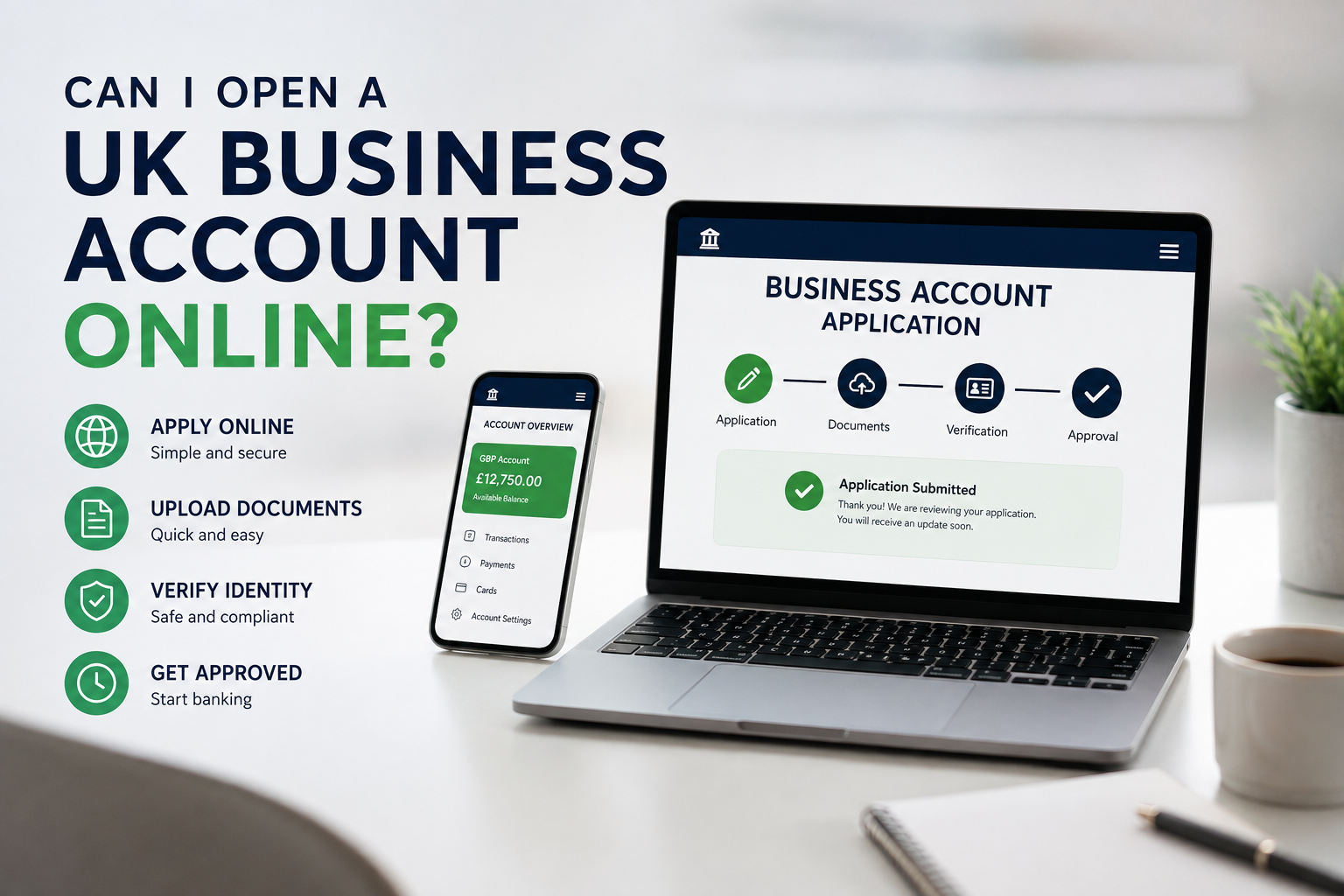
A newly incorporated company may be asked to provide information about its planned activities because it does not yet have an established transaction history.
The provider may request:
Having a complete website and clear business model can make the company easier to assess.
If a UK e-commerce company has overseas directors, one of the first considerations should be eligibility.
There is little value in comparing fees and features if the provider does not accept directors from your country of residence.
Check whether the provider:
After establishing eligibility, compare currencies, payment capabilities and costs.
Neither is automatically better.
Traditional banks may offer a broad range of banking services, while digital financial providers may focus more heavily on online payments, international transactions and currency management.
For an e-commerce company, the best choice depends on the features actually required.
An international online business may prioritise:
Multicurrency → FX → International Payments → Marketplace Payouts
A domestic retailer might prioritise:
GBP Payments → Cards → Accounting → Local Banking
Different businesses therefore require different account structures.
Potentially, yes.
Some businesses use different accounts for different purposes.
For example:
Account 1: Main operating account
Account 2: Marketplace settlements
Account 3: Foreign currencies
Account 4: Taxes or reserves
However, additional accounts also mean additional administration.
A multicurrency account may reduce the need to maintain numerous separate accounts solely for different currencies.
For an e-commerce company, compare the overall package rather than focusing on one feature.
Key areas include:
This provides a more realistic comparison of how the account will perform in everyday business use.
Consider an online company that:
Customers: UK only
Suppliers: UK only
Sales currency: GBP
Supplier currency: GBP
This business may simply need a straightforward GBP business account.
A complex multicurrency account may offer little additional benefit.
Now consider:
Customers: UK and Europe
Currencies received: GBP and EUR
Suppliers: UK and Europe
A suitable setup could potentially support:
GBP + EUR + IBAN + SEPA
The business may then be able to receive and spend EUR without converting every transaction.
Consider a company with:
Customers: UK, Europe and US
Revenue: GBP, EUR and USD
Suppliers: UK, Europe and Asia
This business may benefit significantly from:
GBP + EUR + USD + multicurrency + currency conversion + international payments
Its account requirements are considerably different from those of a domestic online retailer.
For an international e-commerce company, a multicurrency business account can be particularly useful because it may allow the business to receive, manage, convert and pay in currencies such as GBP, EUR and USD.
Not necessarily. If all sales and expenses are in GBP, a standard GBP business account may be sufficient.
Look for an account supporting the currencies in which you receive sales revenue and pay suppliers.
It can be useful if your company receives or sends European bank transfers, particularly in EUR.
If you regularly receive or send EUR payments within the SEPA area, SEPA support can be valuable.
Potentially, but you should confirm that the marketplace accepts the specific account details provided.
Potentially. If your account supports both maintaining and sending USD, you may be able to use USD revenue for USD expenses without first converting it to GBP.
It depends on your transaction profile. For businesses converting significant amounts of currency, FX costs can be much more important than the monthly account fee.
For a UK e-commerce company selling internationally, a multicurrency business account can often provide the most useful combination of flexibility and payment capabilities.
Ideally, the account should match the company's entire payment flow:
Receive → Manage → Convert → Pay
For a global online business, this may mean having access to GBP, EUR and USD, an IBAN, SEPA payments, international transfers and competitive currency conversion.
For a UK-only e-commerce business, a straightforward GBP account may be all that is required.
The best account is therefore not necessarily the one with the lowest monthly fee or the longest list of features. It is the one that best matches where your customers pay from, where your suppliers are located and which currencies your business actually uses.