By

August 24, 2026
What Is a Balance Sheet for a UK Limited Company?
A balance sheet for a UK limited company is a financial statement showing what the company owns, owes and the amount attributable to its shareholders at a specific date.
Unlike a profit and loss account, which shows financial performance over a period, a balance sheet provides a snapshot of the company's financial position at a particular point in time.
In simple terms:
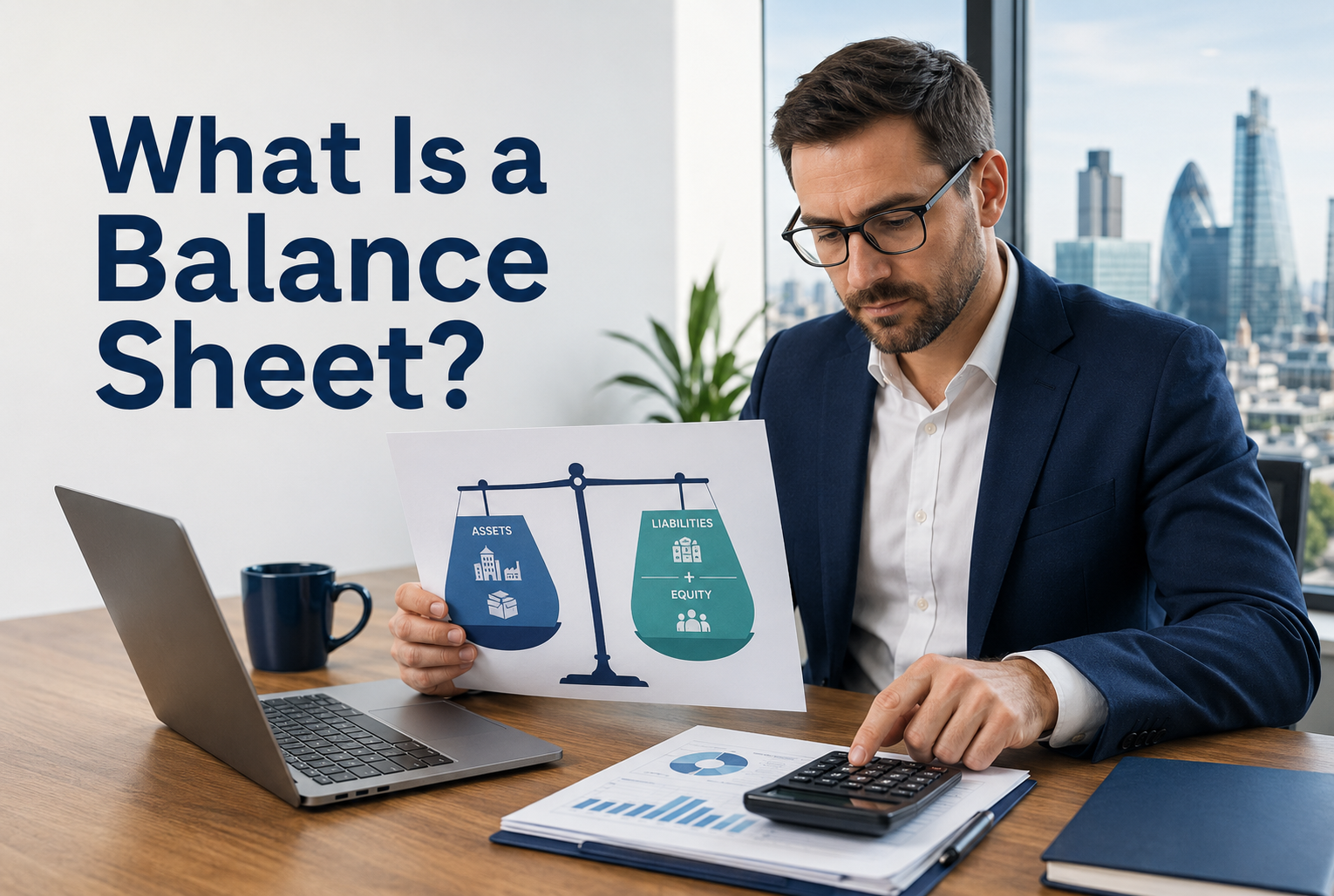
Assets − Liabilities = Shareholders' Equity
A balance sheet is generally divided into three main areas:
These figures help directors, shareholders and other users of the accounts understand the company's financial position.
Assets are resources owned or controlled by the company that have financial value.
They can include:
Assets are commonly divided into current assets and fixed or non-current assets.
Current assets are generally assets expected to be converted into cash, sold or used within the normal operating cycle.
Examples include:
Fixed assets are generally resources the company expects to use over a longer period.
Examples can include:
Liabilities represent amounts the company owes to other people or organisations.
Examples may include:
Liabilities can be separated according to when they are expected to be paid, such as amounts falling due within one year and amounts due after more than one year.
Shareholders' equity represents the residual interest in the company after its liabilities are deducted from its assets.
It can include items such as:
For example, if a company has £100,000 of assets and £40,000 of liabilities, its net assets would be £60,000.
It is called a balance sheet because the accounting equation must balance.
In simplified form:
Assets = Liabilities + Equity
The two sides should therefore reconcile.
UK limited companies generally need to prepare annual statutory accounts, and the balance sheet is a fundamental part of those accounts.
The exact format and disclosures required can depend on the company's size, accounting framework and circumstances.
Directors are responsible for ensuring that the company's accounts comply with the applicable requirements.
UK limited companies generally file annual accounts with Companies House, and these accounts include a balance sheet.
The precise information that must be filed and made publicly available depends on the reporting requirements applicable to the company.
Filing requirements can change, so directors should check the current Companies House rules for their accounting period.
A balance sheet and profit and loss account provide different information.
A balance sheet shows what the company owns and owes at a specific date.
A profit and loss account shows the company's income, expenses and profit or loss over a period.
For example, a company's P&L might show that it made a £30,000 profit during the year, while its balance sheet shows how that profit and the company's other transactions have affected its assets, liabilities and equity at year-end.
Yes, cash held in company bank accounts is normally included within the balance sheet.
However, the company's total assets should not be confused with cash.
A business could have £200,000 of assets but only £20,000 in its bank account because the remaining value could be held in stock, equipment, unpaid customer invoices or other assets.
Yes.
Business loans, unpaid supplier invoices, tax liabilities and other amounts owed by the company can appear as liabilities on the balance sheet.
Reviewing liabilities can help directors understand how much the company owes and when those amounts may need to be paid.
Yes.
If a company's liabilities exceed its assets, it can have negative net assets.
For example:
Assets: £50,000
Liabilities: £70,000
Net liabilities: £20,000
Negative net assets can indicate financial pressure, although the company's overall financial position should be considered carefully rather than relying on a single figure.
Yes. A director can prepare their own UK limited company accounts without automatically needing to appoint an accountant.
Accounting software can help maintain records and produce balance sheet reports.
However, directors remain legally responsible for ensuring the company's accounting records and statutory accounts are accurate and meet the applicable UK requirements.
Accurate bookkeeping is essential.
Useful records can include:
Keeping these records up to date makes preparing year-end accounts significantly easier.
A balance sheet can help UK company directors understand the overall financial position of their business.
It can help answer questions such as:
It can therefore be useful for financial planning as well as statutory reporting.
A balance sheet shows what a company owns, what it owes and the resulting shareholders' equity at a particular date.
A balance sheet is a core part of a UK limited company's statutory annual accounts, subject to the reporting requirements applicable to the company.
No. A balance sheet shows financial position at a specific date, while a profit and loss account shows income, expenses and financial performance over a period.
Yes. Loans, unpaid bills, tax liabilities and other amounts owed by the company can be included as liabilities.
Yes. Company bank balances are normally included as assets.
Yes. Directors can prepare their own company accounts, although they remain responsible for ensuring that the accounts comply with applicable UK requirements.
A balance sheet for a UK limited company is a snapshot of the company's financial position at a specific date.
It shows the company's assets, liabilities and shareholders' equity, helping directors understand what the business owns, what it owes and its overall net financial position.
Together with the profit and loss account, the balance sheet is one of the most important financial statements for understanding the finances of a UK limited company.